International Criminal Court
The International Criminal Court (ICC) was established by the Rome Statute of the International Criminal Court, which was negotiated at a major United Nations conference in 1998. The ICC addresses only the most serious crimes of concern to the international community — specifically, genocide, crimes against humanity, and war crimes — occurring on or after 1 July 2002. It does not address other international crimes such as terrorism. Generally, the ICC acts only in instances where national justice systems are unwilling or unable to carry out investigations and prosecutions. Its jurisdiction is limited to individual persons, as distinct from states or business corporations, and it is separate from the International Court of Justice (ICJ) which deals with legal issues between states. Permanently located at The Hague, Netherlands, the ICC is supervised by an Assembly of States Parties that is also responsible for its ongoing administration. Canadian Philippe Kirsch was elected first President.
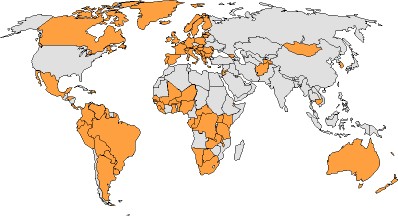 |
| ICC Member Countries |
The permanent establishment of the ICC realizes a broad consensus that certain types of wrongdoing deeply offend global community standards. It embodies respect for the protection, well-being, and autonomy of individuals and groups. Individual autonomy, which implies both rights and duties, also underpins the central principle of individual criminal responsibility. Although some states abstained from the Rome Statute, it is a significant instance of international cooperation. More states will likely join over time, and additional crimes (for example, "aggression") may be added. A 2009 Review Conference will consider these and other issues.