G20
The Group of Twenty (G20) is an international grouping of finance ministers and central bankers that was created in 1999 in the wake of the global financial crises that broke out in Mexico in 1994 and East Asia in 1997. It was intended to be like the G7 which brings together on a regular basis the finance ministers and central bankers from Canada, France, Germany, Italy, Japan, the United States, and the United Kingdom to discuss major issues about the global economy. Like the G7 the G20 is informal, with no permanent secretariat and a rotating chair, in order to encourage meaningful high-level discussion among participants. Like the G7, the practical implementation of policies discussed at the G20 is carried out through the member governments or through formal international organizations such as the International Monetary Fund (IMF). In each case the political and economic importance of the members contributes to the likelihood that agreed policy directions will be implemented.
The G20 includes representatives from the countries in the G7, but also from twelve other "systemically important" countries in global finance (Argentina, Australia, Brazil, China, India, Indonesia, Mexico, Russia, Saudi Arabia, South Africa, Korea, Turkey), along with representatives from the IMF, World Bank and European Union. It is therefore much broader than the G7, a reflection of the need to incorporate more countries in policy discussions as finance has become more globalized. The G20, however, does not also meet at the leaders' level in contrast to the G7 (which, with Russia now meets as the G8), and this limits its effectiveness, although some discussion of creating a L20 to bring the leaders of the G20 together had begun by 2005.
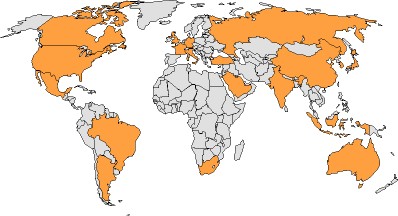 |
| G20 Member Countries |
The G20 is an important example of the way in which new institutions are created to guide the world economy as it has become more globalized, and how these institutions often are relatively informal. Its supporters have seen the G20 as broadening participation in global governance. Critics, however, argue that the G20, which was created at the initiative of the G7, is primarily used to legitimize the initiatives of the G7 with regard to emerging economies, and that the narrower, economic focus of the G20 signals its lack of political capacity relative to the G7.