Monetary Power and Political Autonomy: Exchange Rate Policy-making in Follower States
Louis W. Pauly, University of Toronto
Preface
A key question in studies of economic globalization is how much political autonomy
do smaller states, dependent on larger economic powers, have in devising a monetary
policy that fits well the needs of their citizens. In looking at this question,
Professor Louis Pauly answers: "More than you might think." He takes as his
starting point a crucial policy area: foreign economic policy as it bears upon money
and exchange. He selects two countries, so-called follower states, whose economies
are tightly linked, if not dependent, on major economic powers: Canada and Austria.
Canada's economy is highly interdependent with that of the United States; currently
over 85 percent of Canada's foreign trade is with this one country. Austria has
long been closely tied to Germany's economy.
In a careful review of the foreign economic policies of these two countries in the
era since the end of the Second World War, Pauly demonstrates that both countries
were able to pursue monetary and exchange rate policies that demonstrated political
autonomy. Here autonomy means the capacity to construct policy buffers between
itself and the dominant state that permitted the follower state to pursue interests
that reflected its own needs and those of its citizens rather than those of the
dominant state. In making this argument, Pauly also draws linkages between monetary
policy and varying forms of capitalism, the so-called "varieties of capitalism"
literature. This innovative linkage extends this literature well beyond the areas of
industrial and technological innovation policies which have been its focus. Pauly's
argument thus continues a consistent line in his decade-long research on economic
globalization, one that argues that states, even follower ones, have considerable
policy instruments at their disposal to shape globalization. They are far from
helpless.
William D. Coleman, McMaster University
Common sense suggests that successful leaders need willing followers. Coercion can
sometimes be effective, but even the most inexperienced parent soon learns the
lesson that results achieved through unforced acquiescence tend to be better and
more enduring than those achieved through the application of brute force. Political
theorists typically focus on the concept of legitimacy when they evoke the quality
that transforms raw power into something more acceptable to its target. Clearly
implicated by that concept is another one, even more difficult to measure: respect
for the ultimate autonomy of the target. In an era of rapid global transformation,
when the exercise of great power is readily observable, research nevertheless
proliferates on the meaning and nature of independence, of sovereignty, and of
political autonomy
(Grande and Pauly 2005).
In the international monetary arena, the tendency to concentrate analysis on leading
states and the shifting landscape of systemic power underplays the important matter
of ultimate limits on that power and obscures the enduring quest for autonomy among
follower states. A common assumption, certainly among international economists, is
that all follower states really want from monetary leaders are reliable monetary
anchors, external bulwarks against inflation. As long as the leader provides
stability, the acquiescence of followers is assured. Even if we accept such
reasoning as a starting point for analysis, however, it fails to capture the essence
of observable leader-follower dynamics in the monetary arena.
Despite the integrative effects of economic globalization, few follower states have
ever demonstrated a willingness simply to trust systemic leaders to do the right
thing, to carry through with macroeconomic policies that would automatically promote
and defend interests beyond their own. At the heart of the international monetary
system since 1945, indeed, follower states have typically insisted on taking out
insurance. Sometimes, this has taken the form of participation in collaborative
institutions, where the costs of a policy mistake by a leader can be widely
distributed. At other times, however, follower states have simply constructed
policy buffers under their own control. The most common buffers took the form of
exchange rate regimes and a range of policies affecting the inward and outward flow
of capital.
During the past few decades, as most follower states moved decisively to open their
economies to freer capital movements, a striking divergence developed on the
exchange rate issue. Although no follower states explicitly abandoned the idea of
political autonomy, some opted to combine capital liberalization with exchange rate
floats, while others chose hard pegs. Those inside Europe's monetary union chose
the most rigid form of pegged rates, while also choosing to work collaboratively to
manage their mutual relationship with the US dollar and other reserve currencies.
What explains these different choices?
This paper rests on the assumption that decisions taken in this regard reflect the
deliberate crafting of buffers between followers and leaders, or about efforts by
the weak to constrain the monetary power of the strong. The empirical evidence
presented in the paper will demonstrate the plausibility of this assumption, but its
more rigorous presentation is aimed at probing the reasons behind the choice of
floating or fixed exchange rate regimes among important and similarly situated
follower states at the core of the contemporary international monetary system.
Taking its cue from burgeoning contemporary research on the varieties of capitalism
in the post-1945 period, the paper advances the argument that liberal market
economies tend toward floating exchange rate regimes, while coordinated market
economies tend toward fixed regimes. In the end, such an argument turns on the
prior absence or presence of internal political mechanisms capable of managing the
domestic costs of adjustment to economic forces determined more by leading states
than by follower states themselves.
National Policies and International Monetary Order
I suspect that many economists and most international business people believe the
following: monetary order since World War II has been shaped most directly by a
shifting but generally shared ideological consensus among leading states and a core
group of followers and by the raw power of status-quo-oriented financial elites in
states capable of disrupting the system. Such a view, however, confronts plenty of
evidence of the continuing impulse toward autonomy in both leader and follower
states and of their collective sensitivity to bearing what they themselves perceive
to be disproportionate costs of adjustment to external monetary and financial
disequilibria
(Helleiner 2003). In short, we need something else to account for the
fact that, despite brief episodes of disorder, monetary power was somehow rendered
more or less authoritative in the post-World War II era. At least at the core of
the system, and lately far beyond that core, follower states have accepted as more
or less legitimate the monetary power of system leaders (
Kirshner 2003;
Andrews,
Henning, and Pauly 2002). To use Cohen's terminology, even dramatic changes in
monetary arrangements since 1945 appear to have been perceived as norm-governed
(Cohen 1983). Why did monetary followers follow? How did they reconcile their
desire to maintain autonomy with their pursuit of prosperity through increasing
economic openness? What accounts for continuing diversity in the policies aimed at
that reconciliation?
Policy buffers seem necessary to encourage followership. Of course, conventional
economic thinking may be sound: responsible macroeconomic policies in leader states
will instill confidence and trust in the system. Since such responsibility cannot
be guaranteed, however, follower states appear to insist on maintaining a meaningful
degree of political autonomy within that system. In essence, the ultimate political
contest is over the distribution of the burden of adjustment in an integrating
economic system. Just as safeguards are widely assumed to have made serious
international trade agreements possible during the post-1945 years, the
transformation of monetary power into monetary authority seems logically to have
relied on the existence of limits on the ability of powerful states to shift
adjustment burdens onto less powerful states or to determine how such burdens would
be redistributed inside those states. Unlike much weaker states in the periphery
incapable alone of spawning systemic disorder, follower states at the core of the
system could not easily be coerced (Kirshner 1995). The principled acceptance of
"symmetry" in the process of adjustment was probably never enough to ensure their
willing acquiescence. The external monetary policies of key follower states seem
instead to have been driven by diverse and effective responses to their own
perceptions of vulnerability in a hierarchically ordered system (Cohen 1998; 2004).
An obvious hypothesis suggests itself: follower states at the core of the system
were able to accept international monetary arrangements dominated by leading states
because they ultimately succeeded in constructing autonomous mechanisms capable of
defending their real economies if and when external conditions changed. Such
mechanisms likely always had the same political purpose, even if they differed quite
substantially in form: gaining as much as possible from economic openness without
compromising ultimate political independence. Of course, this is simply another way
of describing the condition long ago dubbed "complex interdependence" (Keohane and
Nye 1977). The real puzzle is why, even when the financial and monetary aspect of
that condition at the core of the system approached deep integration by the dawn of
the twenty-first century, strikingly divergent buffering mechanisms remained readily
observable. The most relevant body of scholarship suggests an answer, even if few
of its advocates have attempted to extend its insights directly to the study of
international monetary power.
Comparative political economists have in recent years convincingly excavated the
enduring foundations for variety in the styles and structures of capitalism, even in
the face of a rapidly globalizing economy. Those same foundations, the
historically-rooted internal arrangements that still constitute national political
economies, seem plausibly to explain the striking diversity in external monetary
policy choices. Such an argument might resolve an empirical puzzle confronting
those of us simultaneously interested in the international politics of money and the
comparative politics of economic adjustment. To be more specific, in the advanced
industrial world — or what I called above the core of the system —
some key follower states resolutely opted for a floating exchange rate regime
vis-à-vis their major trading partner during most of the past sixty years,
while others have just as resolutely opted to peg the value of their currency to
that of their main trading partner. This stark and continuing difference correlates
well with the distinction contributors to the "varieties of capitalism" literature
make between liberal market economies and coordinated market economies (see, for
example, Kitschelt et al. 1999; Hall and Soskice 2001; Hancké and Soskice
2003). Such a distinction, in turn, centers mainly on idiosyncratic arrangements for
wage bargaining and, more generally, for redistributing internally the net benefits
and costs of ever-deepening national involvement in external markets. In short,
certainly since the early 1970s, Anglo-American systems appear to have relied on
floating exchange rates, while continental European and many Asian systems have
preferred pegged or even fixed regimes. Is it possible that more than correlation
is at work here?
One way to address such a question is to take two significant follower states with
long histories of choosing different policy paths and to uncover the reasons their
own policy-makers used for doing so. The balance of this paper does precisely that
by selecting Canada as the perennial currency floater and Austria as the exemplary
fixer. Surprisingly few comparative studies of these follower states exist.1 On the surface, they
each have similarly asymmetrical (and dependent) economic relationships with their
larger neighbours and main trading partners, the United States and Germany
respectively. Under the surface, they have similarly complicated and historically
fraught political relationships with those same states. Still, they have typically
made starkly different choices in the monetary arena.2
As Helleiner (2003) notes, prominent international political economists predict that
currency politics in small, open economies will incline in the direction of exchange
rate stability (see also Frieden 1996; Henning 1994). Despite rapidly increasing
levels of integration with (and dependence on) the United States when it comes to
trade and investment, however, Canada confounded such expectations as it jealously
guarded its national currency and maintained a floating exchange rate for all but
thirteen of the years since 1945. It continues, moreover, to reject the logic of
monetary union. In contrast, facing high levels of economic dependence on Germany,
Austria has long followed the opposite path.
As we examine the reasons for this difference, we are also implicitly exploring the
limits of international monetary power. The two case histories probe the nature of
relationships between followers and leaders.3
My hunch is that to understand the
buffers within those relationships is to understand the boundaries of monetary power
in a system that remains centered on the United States, Germany, and Japan. Perhaps
soon China will join that system fully. Perhaps Russia, Brazil, and India will not
remain forever on its margins. As it has in the past, however, the prospect for
future systemic stability may well depend on the extent to which such power is
rendered into more enduring authority. To the extent it is reasonable to argue that
this depends on the existence and operation of political buffers under national
control, we had better understand the nature of those buffers and the reasons for
their continuing variety.
The Canadian Case
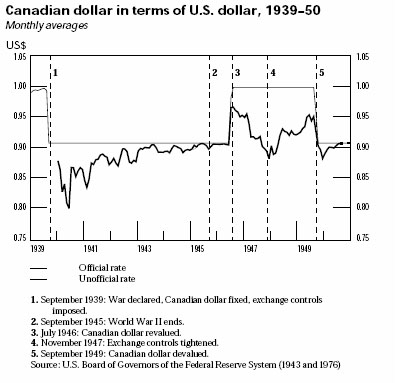
Figure 1 (Powell 1999) suggests a
straightforward story. With the significant exception of the gold standard era, of
the periods of world war, and of the anomalous 1962-1970 period, Canada has relied
heavily on the policy tool of flexible exchange rate adjustment to manage its
deepening interaction with its main trading partner. At three points in the
contemporary period, strategic moves occurred not only in actual exchange rates but
in the very nature of Canada's exchange rate regime. In 1950, it broke away from
its Bretton Woods' commitment by floating the dollar. In 1962, it re-pegged. And
in 1970, it returned to floating once more, a policy that continues to this day with
ever decreasing effort by the Bank of Canada directly to manage the currency's value
and, after 1991, an ever deeper commitment to targeting monetary policy simply on
inflation and hoping that movements in exchange rates complement, or at least not
entirely undercut, movements in interest rates.
 |
| Figure 1 |
During the early post-World War II period, Canada's ties with Britain attenuated,
and the United States rapidly became the only partner crucial to its economic
fortunes. Since 1971, an exceptionally deep economic partnership with the United
States developed; this was finally acknowledged and even embraced in 1988 in the
Canada-US Free Trade Agreement (Pauly 2003; Clarkson 2002). At present, some 87
percent of Canadian exports go to the United States, although in the wake of
transport integration some of this huge proportion (unmeasured by Canadian or US
authorities) represents goods passing through US ports. But we need to back up a
bit if we are to understand exchange rate policy in the context of that larger,
multi-faceted relationship.
One method is to trace the rationales for the three principal changes in Canada's
postwar policy regime (Plumptre 1977; Wonnacott 1965; Fullerton 1986; Helleiner
2005). A key source is the one person who was at or very near the center of policy
decision from 1940 right through to 1973, Louis Rasminsky. Rasminsky managed
Canada's Foreign Exchange Control Board during and immediately after World War II.
He played an important role in the drafting of the Bretton Woods Agreement in 1944,
served as Canada's first director on the International Monetary Fund's (IMF)
executive board, and held the position of deputy governor and, from 1961, governor
of the Bank of Canada until his retirement in 1973. Rasminsky lived a full life,
and was into his ninety-first year when he died in 1998. I had the opportunity to
interview him in 1993 and again in 1998.
Rasminsky termed his presence at the 1942 London meeting where Keynes unveiled his
draft plan for the postwar monetary system, "the highlight of my international
monetary career."4 Like others at that meeting, he was convinced that deflation,
recession, and competitive currency devaluation would be the chief dangers after the
war ended. Keynes' ideas for "a clearing union and code of behavior based on
non-discrimination and convertibility" made a deep impression on Rasminsky, for they
promised an elegant way to avoid recapitulating the dismal monetary experience of
the 1930s. That the plan envisaged stable exchange rates was not the main
attraction, however. Rather, it seemed to chart a politically feasible and
economically sound path back to more freely flowing international capital movements.
"Non-discrimination and convertibility were so important to Canada because of the
structure of our trade then: we had a surplus of imports from the United States,
which we paid for through a surplus of exports to Britain and Europe, and some
capital inflows from Britain but mainly from the United States." Capital controls
were never welcomed for their own sake, but they proved essential during the war
years. They came off again as soon as possible, a process completed in 1951.
Although Rasminsky had a personal inclination toward the idea of exchange rate
stability embodied in the IMF, he claimed always to share with other Canadian
officials a fundamental commitment to easing conditions for international capital
flows. "We were always committed to freely flowing capital, both before then and
ever after."5 That commitment only deepened when the postwar reality became
economic boom instead of bust. With capital flows to Canada, mainly from the United
States, rising rapidly at both of the crucial turning points of 1950 and 1970, "we
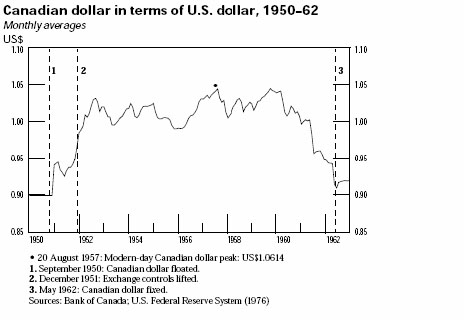
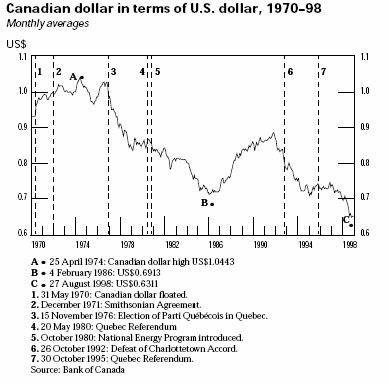
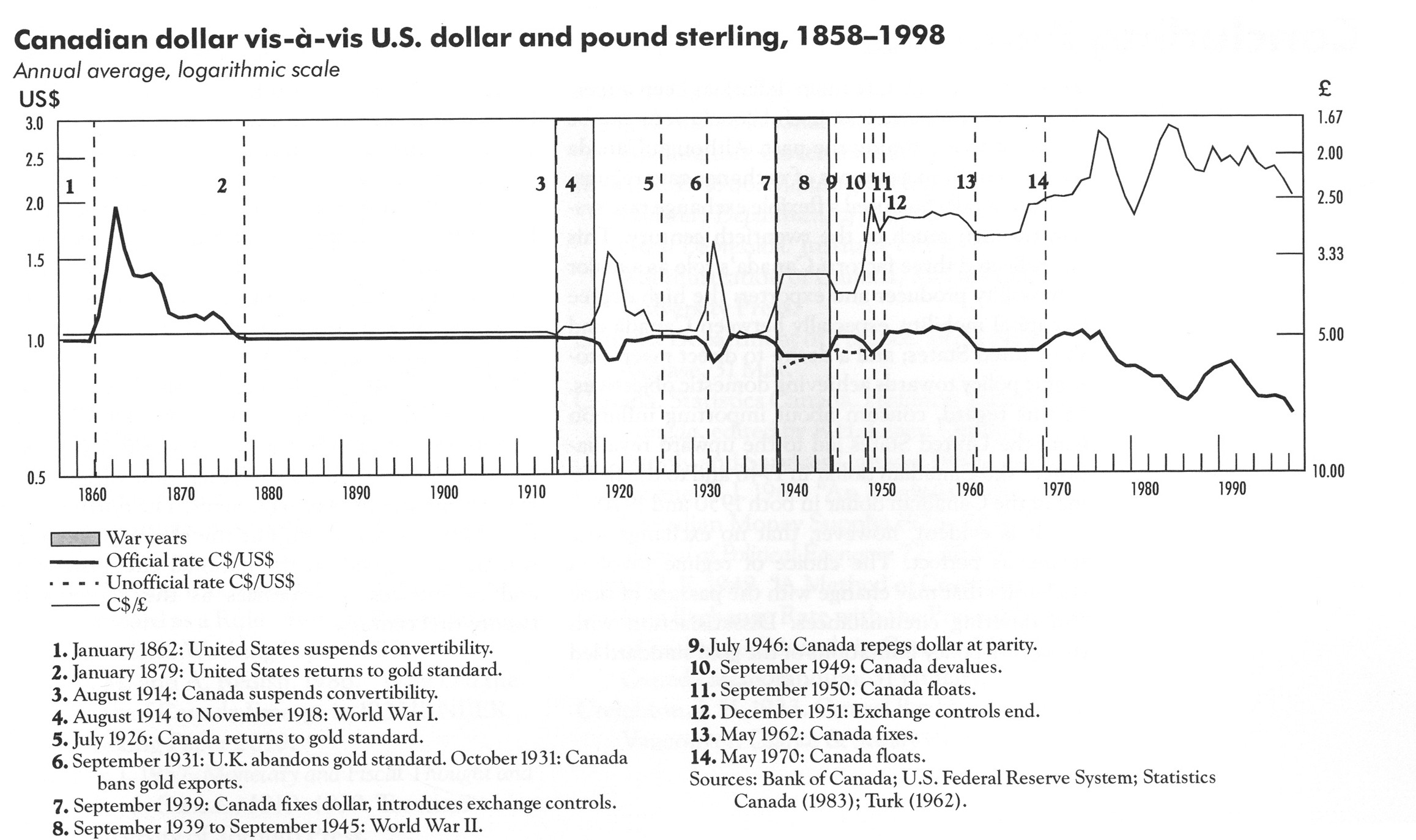
were always willing to sacrifice exchange rate stability if need be." (See Figure
2, Figure 3, and Figure 4 (Powell 1999).) "We didn't relish breaching our Bretton Woods commitments in either case," Rasminsky
recalled, "but what could we do?" "When we floated, we floated up, so we could
always deny competitive devaluation."6
 |
| Figure 2 |
 |
| Figure 3 |
 |
| Figure 4 |
Although some American counterparts understood Canada's position in both 1950 and
1970, rising tension existed at the official level, especially in 1970. For
Rasminsky, this was nothing new. He had hopes even into 1944 that something like
Keynes' politically neutral Clearing Union might succeed. In theory, such a
mechanism could have reconciled desires for both exchange rate stability and capital
mobility, and Canada could have supported it. But Rasminsky soon concluded that the
United States had no stomach for such a multilateral ideal, one which would give
voice and, more importantly, automatic and certain financing to non-Americans when
they faced balance-of-payments adjustment problems. In the late 1940s, he
complained about the niggardliness of Fund financing, and early on he worried that
the Fund was condemned by the United States to be much less relevant than it could
have been. His concern rested on his close observation of US behavior in the
crucial 1944-46 period. A remark he recorded during the 1946 inaugural meeting of
governors of the IMF and World Bank in Savannah, Georgia captured the spirit of the
lesson Rasminsky learned then and carried with him throughout his life: "We have all
been treated to a spectacle of American domination and domineeringness through their
financial power which has to be seen to be believed…US foreign economic
policy seems to be in the hands of the Treasury who are insensitive to other
peoples' reactions and prepared to ram everything they want down everyone's
throat.(Muirhead 1999, 111)"
In 1950, when Canada found itself awash in US dollar reserves, the necessary
consequence of simultaneous export and investment booms, inflation was the rising
threat. US Treasury officials were not in so much of a shoving mood as in a mood of
concern. Even more worried were IMF staffers, who feared that a Canadian
revaluation would set a precedent and undermine the central exchange rate plank of
the Articles of Agreement. Rasminsky saw the problem, but he also now saw serious
design flaws in the structure of the Fund itself. His advice to the Minister of
Finance therefore took the following line. Especially after the formal end of
residual exchange controls, Canada should embrace its full obligations to the Fund
(so-called Article VIII status), but the Fund should be asked to acknowledge the
market conditions facing the country and quietly to exempt it from any obligation to
hold an explicit exchange rate peg or commit itself to reestablishing such a peg by
a certain date (Muirhead 1999, 143). This is exactly what happened. Fifty-three
years later, Rasminsky was forthright in his rationale for the policy he advocated:
"Our commitment to multilateralism mainly had to do with the desire to have a buffer
between us and the United States. Negotiating head to head with them was never
enjoyable. In a way, our position was like Switzerland's. An island of stability
and a great haven for capital flows in a turbulent world. It was often best to keep
our heads down."7
As Helleiner (2005) points out, the decision to float in 1950 was certainly backed
by the weight of opinion in the Canadian private sector. It would be an
exaggeration, however, to say that the actual decision to break Fund obligations and
float the currency originated there. Nor was there much evidence of any
particularly salient partisan influence or serious lobbying by provincial
governments. Not only did central governmental policy-makers value the final choice
of assigning priority to monetary autonomy and capital mobility, they themselves had
a significant amount of policy autonomy within the Canadian political system
actually to make such a choice. In a sense, the actual choice made by Canada's
small group of policy-makers could be seen as "ideational" or even ideological
(McNamara 1998). It seems more accurate, however, simply to call it logical, both in
light of market conditions and their understanding of the decentralized structure of
the Canadian state and the regionally differentiated nature of the national economy.
The only feasible alternative to floating the currency in 1950 would have been a
combination of very loose monetary policy, risking accelerated inflation during an
unexpected period of economic expansion, and the reimposition of capital controls.
Price stability was even then seen to be in the national interest, and so too was
the development of manufacturing in Quebec and Ontario and of commodity-based
businesses in the Maritimes and the West. Private American capital inflows were the
key. If this meant that bankers in Montreal and Toronto would have to continue
living with some hot money, this seemed a small price to pay. (I have seen no
record of loud objections emanating from that quarter.) Was currency speculation
ever really a serious problem? Rasminsky was clear: "No. We didn't build very
many long-term assets with short-term money."8
In light of such reasoning, the decision to re-peg in 1962 was anomalous. Unique
circumstances explain it, but in retrospect the main conclusion Canadian
policy-makers subsequently drew was that it was a mistake. Erratic domestic
economic policy in 1961 set the stage. A trade deficit was exacerbated by an overly
tight monetary policy that simultaneously depressed exports and attracted excessive
capital inflows. In the face of rising unemployment, a populist Conservative
government tried to talk the dollar down, the United States and the IMF began
complaining about competitive currency depreciation, and a politically tone-deaf
central bank governor refused to loosen the monetary reins. That governor, James
Coyne, was eventually fired and Rasminsky took his place. In addition to coming to
a formal understanding with the government concerning the responsibilities of the
Bank of Canada, Rasminsky's immediate task was to help restore confidence in a
Canadian economy beset by rising unemployment.
For a brief period of time, it seemed that one prudent way to do so would be to
accede to US and IMF calls to re-peg the exchange rate. Senior Finance Department
officials noted that there was some pressure from the business community to take
this route, but Rasminsky emphasized the need "to eliminate uncertainty" when, in
May 1962, he announced the decision to fix the rate (Plumptre 1977, 168; Muirhead
1999, 196). In later years, he also insisted that the government would never have
taken that decision if it had not believed that domestic circumstances themselves
had warranted it. In any event, it did not work. The rate immediately came under
pressure as a deteriorating trade position convinced the markets that the Canadian
dollar was overvalued. In order to defend the currency, the government found itself
forced into the classic posture of imposing fiscal stringency, raising interest
rates, and shoring up emergency reserves by borrowing from the Fund and the US and
UK central banks — all, again, in the face of rising unemployment. Once
committed, however, Rasminsky himself could see no other way out, except to urge the
government to take even more direct measures to reduce the current account deficit.
This necessarily implied reducing domestic production costs. He therefore urged
that "Cabinet should consult with business and labor." In the end, such
consultations could not quickly reduce those costs, and the government relied
instead on import surcharges. This antagonized the United States, but soon changed
market psychology. The exchange crisis eventually subsided; the focus of policy
attention shifted later in the decade away from unemployment and back toward
inflation.
By 1970, Canada faced again a situation very similar to that of 1950. Confidence in
the Canadian currency had long since returned; capital rolling now in from the
United States made alternative choices to re-floating the Canadian dollar
unpalatable. As Powell (1999, 49) puts it:
A defense of the [then] existing par value was untenable since it would require
massive foreign exchange intervention, which would be difficult to finance without
risking a monetary expansion that would exacerbate existing inflationary pressures.
A new higher par value was also rejected since it might invite further upward
speculative pressure, being seen by market participants as a first step rather than
a once-for-all change. The authorities also considered asking the United States to
reconsider Canada's exemption from the US Interest Equalization Tax. Application of
the tax to Canadian residents would have raised the cost of foreign borrowing and,
hence, would have dampened capital inflows. This too was rejected, however, because
of concerns that it would negatively affect borrowing in the United States by
provincial governments.
Even under the most aggressive pressure from American Treasury officials, especially
from Secretary John Connally, Canada refused to support the US attempt to shore up
the Bretton Woods system in the negotiations following President Nixon's decision to
suspend the official convertibility of the US dollar on 15 August 1971. Rasminsky
recalled the key negotiating session vividly:
Connally was very rude. We had to float, and I told him privately that we were not
his problem. We were not draining US gold reserves, since we were holding much of
our foreign reserve in the form of non-marketable T-bills. He began yelling about
Canada always having its hand out for one thing or another but never being willing
to help, and I raised my voice in anger. He stormed out of the room. In a public
session later, Connally asked [IMF Managing Director] Schweitzer if Canada was
contravening the Articles. He said yes. But we immediately intervened to ask
Schweitzer if he thought that under the circumstances it would be possible for
Canada to fix a durable par value. He said no. This probably helped put him in hot
water with Connally.9
After the Smithsonian Agreement was announced in December 1971, Canada's
unwillingness to participate in the re-pegging exercise was publicly and bluntly
attacked by Paul Volcker of the US Treasury and by Arthur Burns, then Chairmen of
the Federal Reserve. Canada, according to Burns in 1972, "had not been prepared to
be helpful to the USA in its time of need. (Muirhead 1999, 294)" Underlying Canada's
adamant position, however, was the reawakening of a strong preference for monetary
autonomy. The line of thinking was well articulated as early as 1932 by Clifford
Clark, arguably the country's most important deputy minister of finance ever and the
person who, along with central bank governor Graham Towers, originally recruited
Rasminsky to government service:
Under a policy of fixed exchanges, an upset in the country's balance of payments due
to a crop shortage, or a change in foreign demand for one or more of the country's
important products may have to be corrected by the painful process of restricting
credit and reducing prices and personal incomes. This process appears the more
ruthless when it is realized that many disequilibria in international balances of
payments are temporary in nature. The question may be raised whether the policy of
exchange stability in some cases does not involve the payment of too high a price
for the advantage gained…The arguments against a tie-up with New York and with
London constitute the case for retaining our national autonomy in monetary affairs
for the present at least. In particular, neither alternative offers any real
assurance of price stability or the restoration of our prices to a level at which
the burden of fixed debt upon the shoulders of industrialist and taxpayer will be
appreciably mitigated…If we retain our independence, we may choose our own
objectives and plot our own course towards them.10
What we might call the Clark-Rasminsky shared narrative on Canada's external
monetary and financial polices really extended from the 1930s straight through to
the 1990s and beyond. There has been no basic change in the country's exchange rate
regime since 1971, except for the even stronger commitment to floating represented
by a public understanding that the Bank of Canada would not intervene in foreign
exchange markets even to manage the rate. Such a commitment was harshly tested
during the 1990s, when the exchange rate plummeted to historic lows against the
dollar. To the surprise of many in the business community who continued to push the
cause of fixity, even to the point of monetary union, that commitment held
(Helleiner 2004). The strong recovery in the exchange rate in later years tested it
again from the opposite side. The Clark-Rasminsky consensus survives.
In sum, policy autonomy remains the key Canadian priority. In the wake of the
miserable experience of the 1930s and the shock to Canada's polity and economy posed
by World War II and the rapid erosion of the British Empire, there was a brief
moment when the country's monetary policy-makers were willing to consider new
international arrangements that might have fundamentally compromised that autonomy.
The need for an insulator might have been met by a radically new kind of
international organization. But by 1946, it was crystal clear that no such
organization could be created.11 The normal reaction of those actually charged
with managing Canadian policy quickly reasserted itself, in practice if not always
in rhetoric. The exchange rate would be the main instrument for buffering the
relationship between Canada and the only other economy that really mattered. Canada
wanted to be as helpful as possible in the establishment of the Bretton Woods
institutions. It would take them seriously, it would send respected senior
officials to sit on their boards. Even when it failed to meet the spirit of its
obligations to the Fund, it would go to great lengths before 1973 to ensure that the
Fund formally acceded to its "temporary" derogations. But even during the "golden
postwar era," it would always defend its own way of dealing with the practical
exigencies of external monetary and financial power. Its senior monetary officials
were pragmatic nationalists. Time and again, not wanting to impede the capital
inflows required to underwrite national prosperity nor to accept any serious
external constraints on monetary policy, they made the exchange rate the principal
buffer.
Ironically, the logic and consistent wisdom of this choice was starkly revealed when
Canada's monetary policy-makers made the mistake of re-pegging in 1962. Fearing the
consequences of quickly reversing course, they immediately confronted the core
political contradiction of the Canadian political economy. If external costs could
not be adjusted rapidly as payments pressures mounted, they would have to adjust
internal production costs. But they simply could not do so in a decentralized,
liberal market economy. The fact that the initial error was soon covered over by
the effects of an eventual inflationary boom in the United States in the 1960s
should not confuse the basic issue. In 1970, Canadian policy-makers once again
squarely confronted their internal political limits and reverted to their
traditional external practices. The exchange rate was the essential buffer, the one
capable of being deployed unilaterally and swiftly in a deadly serious game always
played on two dimensions. Internally, if business and labour could not be cajoled
into negotiated concessions to keep national production competitive, then a change
in the value of the currency could accomplish the same end less obtrusively, even if
internal regional effects might be unbalanced. Externally, the same kind of change
could shift some of the costs of adjustment onto others, or more benignly to limit
the shifting of such costs to Canada. Despite external political pressures
motivated by this reality, most prominently in the early 1970s, Canadian
policy-makers steadfastly refused to rely on any other policy mechanism. Blaming
financial markets for changes in living standards always proved a workable political
strategy, both internally and externally. It essentially managed the irresolvable
tension between continental economic integration and national political
independence.
Despite tremendous changes in the real economy of Canada since the 1970s, including
freer trade with the United States, the explicit adoption of inflation targeting in
1991, and dramatic fiscal restructuring in the mid-1990s, this logic continues to
hold.12 External shocks continue ultimately to entail abrupt changes in the
demand for Canadian goods and services, the composition of which varies markedly
across the country's regions. In the face of such shocks, one could certainly
imagine an alternative adjustment mechanism focused mainly on the movement of labour
or on relative changes in sectoral wages. But even in a post-NAFTA era, the
movement of labour across the Canada-US border is still more difficult and less
common than the movement of labour within the country, and it remains the case that
relative wages right across Canada's regions are sticky in nominal terms (Helliwell
1998).
The question of whether smoother and deeper continental adjustment will be possible
in the future is an open one, which overlaps with the quiet expert debate usually in
the background on the extent to which a separate currency now comes with mounting
transaction costs in markets Canadian policy-makers can rarely influence. Booming
cross-border trade and investment during the past decade suggest that such costs are
low, but the jury is out until more empirical work is done. The Clark-Rasminsky
consensus nevertheless continues to hold: as long as monetary policy is
disciplined, a flexible exchange rate facilitates macroeconomic adjustment and
stabilization in a continental economy, while simultaneously carving out a
relatively high degree of political autonomy for the Canadian state and the
decentralized national society it still seeks to steer.13
The Austrian Case
Austrians understand what it means to confront power. When the democratic Republic
of Austria was reconstituted on 27 April 1945, Germany had yet to surrender and the
country was occupied by the Soviet army. Allied troops were approaching from the
west, and their governments had yet to recognize the new state. Ironically,
although the country had been shattered by external forces more thoroughly than in
1918, the traumatic experience of the previous seven years effectively incubated a
new sense of national
identity. In a hostile environment, a new nation and a new
state initiated a complicated process of mutual construction. Especially after the
State Treaty of 1955 finally ended the Allied occupation, monetary policy became an
important instrument in that task. Where only 47 percent of its people considered
themselves to be members of an Austrian nation in the mid-1960s, within a quarter
century some 80 percent embraced just such an identity (
Riedlsperger 1991;
Katzenstein 1977). The performance of the Austrian economy, and of the schilling,
surely played no small part in this transformation. A small group of monetary
policy experts understood from the beginning the deeply political nature of their
own assignment. Like their Canadian counterparts, they may fairly be labeled
pragmatic nationalists, but their pragmatism led them in distinctly different
directions.
For those Austrian monetary policy-makers who remember the postwar atmosphere or who
remember what their forebears told them about it, two vivid impressions stand out.
The first is the pall cast over all discussions concerning money by the
hyperinflation of the early 1920s and by the way it ended, with the state in
receivership and the national financial accounts directly administered by a Dutch
national assigned by the League of Nations (Pauly 1997). The League commissioner
left in 1926, but by then the new Austrian National Bank was firmly established.
The law creating it on 24 November 1922 committed the Bank to one overriding
objective: safeguarding the stability of the currency. Even though the subsequent
fixed rate between the new schilling and gold had to be devalued by 28 percent at
the start of the Great Depression, support for a hard currency survived until German
troops were welcomed on 12 March 1938.
The fact that the Germans proceeded to loot the National Bank's reserves might have
been forgotten if the Second World War had turned out differently. But the memory
of that trauma among others was certainly useful to the builders of the Second
Republic. So too was the predictable postwar inflation. In rapid succession, the
resurrection of the Austrian National Bank, the reintroduction and devaluation of
the schilling, and the passage of the Currency Protection Act of November 1947
initiated a process of monetary stabilization.14 Underpinning the restoration of
monetary sovereignty was the first of five wage and price agreements between
organized Austrian industry and the national trade union association, the foundation
of the modern "social partnership," the heart of a coordinated market economy.
Bitter memories of debilitating industrial and class conflict during the inter-war
years framed that progressive-sounding but distinctively illiberal idea.15 Price
inflation was also in the background, and not just in people's memories. Not until
1952 did tightening monetary policies rein prices in. Exchange controls and a dual
exchange rate remained until the next year, when a one-time devaluation of the
schilling was matched with the declaration of a fixed link to the US dollar. On
this basis, Austria was able to join the IMF, and in 1958 to move with other
European states to a single exchange rate system and full currency convertibility.
By then, the social recommitment to the monetary orthodoxy of the late 1920s had
been tested and found durable. Despite the rebirth of passionate debates over the
famous Austrian black-red political divide, the base of support for price stability
remained broad and deep. It found expression in a 1955 act affirming the continuity
since 1922 of the National Bank and recommitting it to currency stability. Among
other things, the capacity of the Bank for independent action was widened through a
grant of powers to regulate the minimum reserves held by banks and to conduct open
market operations without prior approval from the government. This kind of central
bank "independence" in Austria, as elsewhere, is not as uncomplicated a notion as it
might at first appear.
If by the 1950s Austrians did not yet fully trust themselves to maintain a sense of
national solidarity for internal reasons, external conditions would provide
reinforcement. Social partnership meant that organized business groups, the
national farmers association, and workers ultimately organized under the peak
association of the trade union federation (ÖGB) would be authorized to make
national bargains. Once made, economic agreements in core sectors would effectively
apply to all participants in national markets, and those agreements would be
considered technically separate from ideological competition. Domestic politics, in
turn, would be guided by principles of federalism, proportional representation, and
the continual redivision of the spoils of power along red and black lines
(Proporzsystem).16 The fact that internal stabilizing measures had failed
catastrophically before 1938 undoubtedly contributed to a continuing sense of
vulnerability. But so too did the long shadow of the Soviet Union. Milivokevic
cuts quickly to the heart of the matter.
[The four power] occupation only ended when all the parties to the ten-year Austrian
deadlock agreed that the only possible and mutually acceptable status of a sovereign
Austria was permanent neutrality based on the Swiss model. Anything else would have
meant the formal partition of Austria…In deference to Austrian sensibilities, there
was no mention of permanent neutrality in the Austrian State Treaty of 15 May 1955,
although the precondition for the Soviet signing of this Treaty was unconditional
Austrian acceptance of permanent neutrality in the Moscow Memorandum of 15 April
1955…In the famous constitutional law of 26 October 1955, the Austrian government
formally proclaimed: "For the purpose of the permanent maintenance of her external
independence and for the purpose of the inviolability of her territory, Austria of
her own free will declares herewith her permanent neutrality, which she is resolved
to maintain and defend with all the means at her disposal. (Milivokevic 1990, 72;
also Cronin 1986)
But how to build up those means? History and geography pointed only one way:
economic interdependence with Germany, together with the construction of a robust
and distinctly Austrian identity. Katzenstein (1985) traces the delicate processes
through which Austrians went down precisely this road after 1955. But he spends
surprisingly little time on the monetary dimension of their crafting of the
institutional and then functional sinews of a secure nation. The necessity was to
find, and find quickly, non-military policy levers simultaneously to buffer the
power of former adversaries and the future power of a resurgent Germany: to take
the best from the outside world but to leave the rest. In this regard, where the
Canadians relied on a flexible exchange rate to accomplish such a task, the
Austrians consistently made the opposite choice.
During the delicate years after neutrality was proclaimed, the independent design of
Austria's fixed exchange rate regime was acceptable both to the Soviet Union and to
the Americans. Over time, such a regime proved stable because it tended to be
underpinned by anti-inflationary monetary policies. Most importantly, the essential
buffering mechanism necessitated by simultaneous preferences within Austria for both
economic openness and political autonomy was internalized.17 In short, a hard
currency was welded successfully to stable postwar social arrangements for
distributing internally the economic and political costs (and benefits) of gradually
opening the country once again to the world economy mainly through Germany.
Although political neutrality was an existential necessity for postwar Austria, the
practical priority was to recover and rebuild the economy as rapidly as possible.
Natural advantages and traditional networks reasserted themselves. Strong,
export-led growth was crucial, and for a land-locked country in the heart of central
Europe, diversification options were limited. The path reopened after the war would
lead within fifty years to an economy where trade would comprise over 60 percent of
GDP, nearly 40 percent of exports and imports would be to and from Germany (Italy
next at around 9 percent), trade in goods would result in a perennial deficit
requiring balancing receipts from services (like tourism) and investment.
Manufacturing, however, always played the central role in the strategy for recovery
and prosperity. Prevented by its neutrality commitment from joining the European
Community in its early days, few doubted the practical necessity of redeveloping
bilateral linkages with Germany in such industries as machine tools, chemicals,
metal goods, and steel. That basic idea certainly appealed to the labour unions in
what had always been a highly organized workforce. At its root lay the logical
necessity of keeping Austrian wages competitive with German wages. Logic is one
thing, however, and natural human impulses another. How to manage the trick? Enter
the exchange rate regime.
It is true that there was no automatic consensus on the notion of fixing the
bilateral Austrian/German rate at a level marginally favourable to the cause of
Austrian competitiveness. Certainly no one could talk of such things openly. For
one thing, German workers would not like to hear it. For another, after 1955 the
Russians were highly attentive to such matters and anything that sounded like
bilateral concertation sounded like a new "Anschluss" to them.18 Austrian
employer groups and industry leaders, moreover, were of two minds. They understood
the logic of bilateralism, but they also hoped to create options for export
diversification in the future. In this light, a flexible exchange rate, especially
a downwardly flexible one, could in principle be of considerable assistance.19
Along that latter line, even labour unions focused on Germany could be tempted by
the lure of devaluation.
During the 1960s, such matters were not so much the subject of academic disputation
as of practical experimentation. In 1961 and again in 1969, a broad revaluation of
the Deutsche mark on world markets seemed to present an opportunity. Recall that at
this time, the schilling was formally pegged to the dollar and did not automatically
follow the mark upwards. The social partners — business, labour, and
government — clearly hoped in each case that the opportunity would open new
markets for Austrian exports. What they experienced in fact was domestic inflation,
with real and palpable wage losses. Pensioners and others on fixed incomes spoke
darkly about the 1920s. Central bank officials eventually used the experience then
and now to teach a lesson about real effective exchange rates to all who would
listen. It seems doubtful, however, that such education can explain the depth of
the political commitment of both workers and bosses to a fixed exchange rate ever
since 1969. In any case, as Table 1 indicates,
afterwards only minor adjustments occurred in the nominal bilateral exchange rate.
Since the early 1980s the rate has been completely frozen (Winckler 1993). Those
final nominal changes are nevertheless worth more attention, for they marked the
point at which buffering mechanisms were deemed most clearly to be needed between
powerful economic forces and countervailing political exigencies.
Table 1: Austrian Schillings per German Mark
| 1955 | 6.19 |
| 1960 | 6.19 |
| 1965 | 6.48 |
| 1970 | 7.09 |
| 1975 | 7.08 |
| 1980 | 7.12 |
| 1985 | 7.03 |
| 1990 | 7.03 |
| 1995 | 7.03 |
No change since December 31, 1998, when the same nominal rate was converted to AS13.76 per euro.
Source: Austrian National Bank data.
Central bank officials from the 1960s recall the governor and the finance minister
spending considerable time with trade union officials, especially with the head of
the ÖGB, explaining the wisdom of a productivity-based wage policy. Such a policy
centered on the fixed link to the Deutsche mark (DM) and a follow-the-leader
strategy on both interest rates and labour costs. The beauty of the Bretton Woods
system was that no one had to be explicit about this. The excessive inflation
experienced after the DM revaluations in the later years of that system suggested
that Austria should simply have realigned in lock-step, a lesson union leaders were
willing to acknowledge. But the central bankers also recall confronting resistance
to this reasoning from business groups and the chancellor, as well as from the IMF.
From the Fund's point of view, Austria's structural trade deficit suggested then and
well into the 1970s the need for a devaluation of the schilling. The moment came to
square the political circle when the Bretton Woods arrangements finally began to
break down.
At one level, the 1971 devaluation of the dollar and the final decision to float in
1973 raised an obvious, awkward and politically sensitive problem. Inside Austria
an understanding had emerged among the social partners concerning the basic
industrial strategy decisively shaped by Austrian-German networks. The
straightforward monetary dimension of this reality before 1971 meant simply
importing low inflation from Germany via a fixed link between the DM and the dollar.
To the extent this may sometimes have necessitated flexibility in wages and
production costs inside Austria, the social partners stood ready to comply.20
As the dollar ceased to be a reliable anchor for that core relationship, however, it
initially proved impossible to shift to an explicit schilling-mark link. Two things
were at work. First, the Russians were still interested and still watching, and
even if they were not Austrian policy-makers were still absolutely convinced
otherwise (right through to the 1980s). Second, in its own deeply conflicted,
historically-conditioned way, Austrian nationalism was now a political fact. In the
ironic phrase of one former governor, this meant, and still means, Austrian policy
had to be one of "autonomous solidarity" with Germany.21 What this essentially
translated into in the early 1970s was tying the Austrian schilling explicitly to a
basket of European currencies while implicitly pegging it to the Deutsche mark.
Inside the central bank, considerable analytical resources were devoted to
calculating the basket rate on a daily basis and, whenever necessary to keep the
implicit peg rigid, to rejigging the basket. For Bank traders engaged in actual
open market operations, however, the task was uncomplicated. The target was
understood. For those who set Austrian interest rates, somewhat more delicacy was
required. Eventually, a standard practice emerged; the board would meet the same
day the Bundesbank board met; and whenever the Bundesbank changed its base rate, the
National Bank would within the hour "autonomously" decide to match it.
Only in 1975, in unusual political circumstances, was there a brief attempt to step
away from the post-Bretton Woods consensus by allowing a slight depreciation of the
schilling. Once again, certain business groups and trade union leaders were
apparently tempted by a strengthening mark to expand exports and secure an "extra"
wage increase, partly to compensate for price hikes occasioned by the Organization
of Petroleum Exporting Counties' (OPEC) continuing actions in world oil markets
(Winckler 1993). When the National Bank chose not to follow the Bundesbank in one
particular interest rate hike, a brief run on the schilling ensued, significant
reserves were lost, and accelerating inflation again followed. The lesson of money
illusion was re-learned, and the traditional consensus reasserted itself. One
central bank official recalls that in the year following this incident, the
chancellor for the first time explicitly defended the necessity of the fixed tie to
the Deutsche mark in talks with senior trade union officials.22
One final political struggle occurred in 1978-79, when the chancellor and the
finance minister took different sides on the question of how to restructure aging
industries like steel. The IMF and the Organisation for Economic Co-operation and
Development (OECD), in particular, were quite critical of the excessive rigidity
introduced in this context by the DM peg. As one National Bank official explained,
"We knew that if we gave up the peg, it wouldn't have changed anything; we also
noted the experience of Norway and Sweden, for they had abandoned external
discipline but without positive results."23 In any event, the Bank briefly
delayed responding to one rise in German interest rates, a minor devaluation of the
schilling ensued, and the skeptics again proved right. Shortly thereafter, the
devaluation was reversed and the exchange rate rigidly (but unofficially) fixed at
7.03 schillings to the DM. When a similar controversy with the IMF occurred in
1991, the government and the central bank rejected outright the advice to loosen the
hard currency policy, and they even demanded a rewriting of the Fund's annual
performance assessment of the country.
Throughout the 1990s and until today, the hard-currency consensus remains dominant,
even if the success of the peg continue to be subject of some debate both externally
and internally.24 It certainly has made issues of fiscal adjustment more
difficult to avoid and contributed to recent political crises, especially associated
with the difficult challenge of pension reform.25 The rise of the Freedom Party
and its frontal attack on the social partnership system brought underlying tensions
to the fore in the mid-1990s. A few years later, however, one would be hard-pressed
to find evidence of dismantlement (Heinisch 2000).
The end of the Cold War, the 1994 move to join the European Union (EU), and the
subsequent decision to become a founding member of European Monetary Union (EMU)
opened a new chapter in this continuing story. On one level, there is no puzzle
surrounding the ease with which the schilling followed the mark into EMU. The fixed
link of both currencies to the euro simply replaced a bilateral connection. On
another level, however, a subtle but important change was involved.
The history of Austria's efforts to move beyond the dogma of neutrality as the Cold
War was ending and European integration was deepening and broadening is a
fascinating subject, but one which goes beyond the scope of this paper. For present
purposes, it is just necessary to note the clear-eyed perception of Austrian
monetary policy-makers as they oversaw the transition from the era of the hard
schilling to the era of the euro. At base, the move meant abandoning a reliable but
relatively passive set of policy practices. After the euro was adopted, the notion
of "autonomous solidarity" with Germany became less of an ironic turn of phrase. By
joining EMU, Austria now gained meaningful voice in the making of the monetary
policy it now explicitly shared with Germany and other European partners.26 To be
sure, the volume of the Austrian voice would not match that of Germany or France in
the arcane processes through which European monetary policy would be set. But
Austria had no voice in the Bundesbank when it used to matter, and it now did indeed
have a voice when the European Central Bank was decisive. Through EMU Austria was
able to maintain its hard currency policy in relation to Germany. It also now had
two buffering mechanisms as it confronted external markets and the raw monetary and
financial power of Germany and others: a cooperative multilateral institution of
which it was now an intimate part and a continuing internal capacity to match
changes in German production costs.27
Conclusion
"Trust, but verify," Ronald Reagan famously advised Americans when they sought new
arms control arrangements with the Soviet Union in the 1980s. If he had been a
monetary policy-maker in Canada or Austria any time since 1945, he may similarly
have opined, "Cooperate, but maintain room for maneuver." As in other arenas of
power, neither Canada nor Austria ever really wanted to challenge the international
monetary policies of the leading states on their borders. But those policies
affected them and could not be ignored. Their states wanted to get as much as they
could for their societies from multi-faceted economic relationships, but they also
sought to build and maintain separate nations.
28 To accomplish their objectives,
carving out as much practical autonomy as possible was the critical task. In
essence, this meant crafting institutional and policy buffers, the operation of
which could be at their own discretion. There were limits to international monetary
power, and they would define those limits for themselves.
In the face of such follower strategies, what was left for the leaders?
Acquiescence, when they were wisely led. Purposeless confrontation, when they were
not. It is often claimed that it is the willing acquiescence of followers that
transforms coercive power into authoritative leadership. In the two special
relationships explored in this paper, however, acquiescence by leaders to the
existence and use of effective buffers was the wise response. Coercive attempts to
make the follower change strategic tracks, for example, most overtly in the 1971
US-Canada dispute, failed.
Across the Canadian and Austrian cases, it is not the existence of buffers in the
crucial bilateral currency relationship that varies but their character, which
appears functionally related to the deeper historical trajectory of their internal
political economies. In both cases at particular times, windows opened on the
possibility of serious participation in truly multilateral institutions that just
might substitute for other buffering mechanisms. Only very recently in the
German-Austrian case, did such a choice seem partially to satisfy the needs of the
follower state. In terms of effectively responding to an insistence on a voice in
making shared monetary policies, the European Central Bank (ECB) may satisfy Austria
in a way not dissimilar from the way Rasminsky once hoped a Keynesian Currency Union
might satisfy Canada. Austria may be said, therefore, to wield in institutional
terms somewhat more external monetary influence, if not power, than Canada does. In
the end, however, it remains doubtful that cooperative multilateral mechanisms have
convinced many people in either country that they should be relied upon as the
ultimate political buffers. Austria and Canada both retain their own central banks,
and both continue, each in their own ways, tenaciously to defend their room for
maneuver in the context of integrating regional economies.
In the Canadian case, the final buffer in the monetary arena would always be a
flexible exchange rate. Only once was another briefly imagined. When Rasminsky
advised the federal Cabinet to consult with business and labour groups on measures
to support a re-pegged exchange rate, he meant coordinated measures to render
domestic prices and wages downwardly flexible. This was a pipedream. Canadian
society lacks the sense of solidarity and social cohesion either to design or to
implement such measures. "The ideology of social partnership" has no counterpart in
liberal Canada. But neither does the alternative ideology of "neo-liberalism"
resonate deeply in a dualistic nation built across diverse regions. Since 1945, a
flexible exchange rate has been the key political instrument available to the
Canadian state. It is the one instrument under national control that can limit the
capacity of the Americans to export the costs of bilateral adjustment. It is also
the one instrument the state has at its disposal to ameliorate adjustment burdens
generated within Canada and to redistribute them across a fractious society. Even
if certain mobile factors of production could avoid taking their full share of such
burdens, there was no substitute for the flexible exchange rates as Canadians
collectively sought maximal gains from increasingly integrated continental markets.
That particular buffer made it possible to follow the leader on their own terms.
Austria could have pursued a similar course over the decades since World War II.
Certainly many Canadian economists would have expected them to do so, as did the
IMF. At times, even industrialists within Austria advocated exchange rate
flexibility. Actual experience suggested otherwise. Useful for those advocating a
hard currency policy were memories of the 1920s, but especially important was a
remarkably enduring social consensus on the wisdom of keeping inflation low to
ensure that Austrian production costs would always marginally undercut competing
German costs. Still, such a consensus would have meant little in the absence of
workable political mechanisms for rendering real prices and wages within Austria
seriously flexible when circumstances so required. The social partnership system
born in the bloody class conflict of the interwar period proved robust enough for
this purpose throughout the postwar era. Some skeptical observers now argue that
the country's coordinated market economy is under serious threat, as the necessity
of pension reform and rising regional demands push it to the breaking point. Such a
contention remains doubtful, at least with respect to monetary policy, and it
downplays the historical success of implicit flexibility within Austria's
coordinated market economy. Capitalism continues to manifest variety in both its
internal and external dimensions.
It may be true that only follower states in the advanced industrial core can now
craft, defend, and use such buffers at the interface of their societies and
international markets. There is, however, no reason to accept the assertion that
globalizing markets now render autonomy impossible for all but a few. As the
Canadian and Austrian exchange rate cases suggest, diverse national strategies
remain possible and specific policy choices may reflect internal political and
social arrangements more than external economic constraints.
Acknowledgement
Early versions of this paper were presented at the annual meeting of the
International Studies Association, 17-20 March 2004 and at the European University
Institute, 16 May 2004. For constructive comments, I am grateful to David Andrews,
Stephen Harris, Beth Simmons, and Bob Hancké. For generously sharing original
empirical material on the two main cases, I am deeply indebted to David and to Eric
Helleiner. Eduard Hochreiter, Georg Winckler, and Aurel Schubert proved of great
assistance in Vienna. In Ottawa, during his last years, Louis Rasminsky graciously
shared his recollections. Financial assistance came from the Social Sciences and
Humanities Research Council of Canada and from the Robert Schuman Centre for
Advanced Studies. A revised version of this paper will be published as a chapter in
International Monetary Power, edited by David Andrews, Ithaca, NY: Cornell
University Press, forthcoming.
Works Cited
Abdelal, Rawi. 1998. The politics of monetary leadership and followership: Stability in the European monetary system since the currency crisis of 1992. Political Studies 46:
236-59.
Andrews, David, C. Randall Henning, and Louis Pauly. eds. 2002. Governing the world's money. Ithaca:
Cornell University Press.
Breuilly, John. 2002. Austria, Prussia and Germany 1806-1871. London:
Longman.
Clarkson, Stephen. 2002. Uncle Sam and us. Toronto:
University of Toronto Press.
Cohen, Benjamin J. 1983. Balance-of-payments financing: Evolution of a regime. In International regimes,
ed. Stephen Krasner,
457-78. Ithaca:
Cornell University Press.
Cohen, Benjamin J. 1998. The geography of money. Ithaca:
Cornell University Press.
Cohen, Benjamin J. 2004. The future of money. Princeton, NJ:
Princeton University Press.
Cooper, Andrew, Richard Higgott, and Kim Nossal. 2004. Relocating middle powers: Australia and Canada in a changing world. Vancouver, BC:
UBC Press.
Cronin, Audrey. 2004. Great power politics and the struggle over Austria, 1945-1955. Ithaca:
Cornell University Press.
Frieden, Jeffrey. 1996. Economic integration and the politics of monetary policy in the United States. In Internationalization and domestic politics,
ed. Robert Keohane and Helen Milner,
108-36. Cambridge:
Cambridge University Press.
Fullerton, Douglas. 1986. Graham Towers and his times. Toronto:
McClelland and Stewart.
Grande, Edgar and Louis W. Pauly. eds. 2005. Complex sovereignty: Reconstituting political authority in the twenty-first century. Toronto:
University of Toronto Press.
Hall, Peter and David Soskice. 2001. Varieties of capitalism. Oxford:
Oxford University Press.
Hancké, Bob and David Soskice. 2003. The political economy of EMU: Political exchange, wage setting, and macro-economic policy. In Final report for project 2000-203-1, Institutionen, Wirtschaftswachtum, und Beschäftigung in der EWU. Berlin, Germany:
Wissenschaftszentrum.
Heinisch, Reinhard. 2000. Coping with economic integration: Corporatist strategies in Germany and Austria in the 1990s. West European Politics 23
(July):
67-96.
Helleiner, Eric. 2003. The making of national money: Territorial currencies in historical perspective. Ithaca:
Cornell University Press.
Helleiner, Eric. 2004. The strange politics of Canada's NAMU debate. Studies in Political Economy 72
(Winter):
567-89.
Helleiner, Eric. 2005. A fixation with floating: The politics of Canada's exchange rate regime. Canadian Journal of Political Science 38
(1):
1-22.
Helliwell, John F. 1998. How much do national borders matter? Washington, DC:
Brookings Institution.
Henning, C. Randall. 1994. Currencies and politics in the United States, Germany, and Japan. Washington, DC:
Institute for International Economics.
Holmes, John. 1981. Life with uncle: The Canadian-American relationship. Toronto:
University of Toronto Press.
Kaelberer, Matthias. 2004. The euro and the European identity: Symbols, power, and the politics of European monetary union. Review of International Studies 30:
161-78.
Katzenstein, Peter. 1977. The last old nation: Austrian national consciousness since 1945. Comparative Politics 9
(2):
147-71.
Katzenstein, Peter. 1984. Corporatism and change. Ithaca:
Cornell University Press.
Katzenstein, Peter. 1985. Small states in world markets. Ithaca:
Cornell University Press.
Katzenstein, Peter. 2003. Small states and small states revisited. New Political Economy 8:
9-30.
Keohane, Robert S. and Joseph S. Nye. 1977. Power and interdependence: World politics in transition. Boston:
Little, Brown.
Kirshner, Jonathan. 1995. Currency and coercion. Princeton, NJ:
Princeton University Press.
Kirshner, Jonathan. ed. 2003. Monetary orders: Ambiguous economics, ubiquitous politics. Ithaca:
Cornell University Press.
Kitschelt, Herbert, Peter Lange, Gary Marks et al. eds. 1999. Continuity and change in contemporary capitalism. Cambridge:
Cambridge University Press.
McNamara, Kathleen. 1998. The currency of ideas. Ithaca:
Cornell University Pres.
Milivokevic, Marko. 1990. Neighbours in neutrality: Aspects of a close but delicate relationship. Journal of Politics and Society in Germany, Austria, and Switzerland 3
(1):
69-83.
Muirhead, Bruce. 1999. Against the odds: The public life and times of Louis Rasminsky. Toronto:
University of Toronto Press.
Pauly, Louis W. 1997. Who elected the bankers? Surveillance and control in the world economy. Ithaca, New York, and London:
Cornell University Press.
Pauly, Louis. 2003. Canada in a new North America. In The rebordering of North America,
ed. P. Andreas and T. Biersteker,
90-109. New York:
Routledge.
Pichelmann, Karl and Helmut Hofer. 1999. Austria: Long-term success through social partnership. London:
International Labor Organization Employment and Training Papers, No 51.
Plumptre, A.F.W. 1977. Three decades of decision: Canada and the world monetary system, 1944-75. Toronto:
McClelland and Stewart.
Powell, James. 1999. A history of the Canadian dollar. Ottawa:
Bank of Canada.
Riedlsperger, Max. 1991. Austria: A question of national identity. Journal of Politics and Society in Germany, Austria, and Switzerland 4
(Autumn):
56-62.
Rothbacher, Albert. 1995. EU accession and political change in Austria. Revue d'Intégration Européene 19/1
(Autumn):
71-90.
Scharpf, Fritz and Vivien Schmidt. 2001. Welfare and work in the open economy. Volumes 1 and 2. Oxford:
Oxford University Press.
Schembri, Lawrence. 2003. Exchange rate policy in Canada: Lessons from the past, implications for the future. Britain and Canada and their Large Neighbouring Monetary Unions, University of Victoria, 17-18 Octob.
Schmidt, Vivien. 2002. The futures of European capitalism. Oxford:
Oxford University Press.
Simmons, Beth A. 1994. Who adjusts? Domestic sources of foreign economic policy during the inter-war years. Princeton:
Princeton University Press.
von Riekhoff, Harald and Hanspeter Neuhold. eds. 1993. Unequal partners. Boulder, CO:
Westview.
Winckler, G. 1993. The impact of the economy of the FRG on the economy of Austria. In Unequal partners: A comparative analysis of relations between Austria and the Federal Republic of German and between Canada and the United States,
ed. Riekhoff and H. Neuhold,
154-68. Boulder, CO:
Westview Press.
Wonnacott, Paul. 1965. The Canadian dollar, 1948-62. Toronto:
University of Toronto Press.
Notes
1.
The trailblazer here is von Riekhoff and Neuhold (1993). The volume includes a
few paragraphs on Austria's exchange rate policy by the distinguished economist
Georg Winckler, but practically nothing on the Canadian comparator.
2.
Katzenstein's directly relevant insight concerning successful small states in a
globalizing economy is that their economic policies are shaped by broadly shared
perceptions of vulnerability, by social learning, and by attendant efforts to
construct effective tools for defending their national interests (Katzenstein 1984;
1985; 2003).
3.
On the concepts of leadership and followership in this arena, see Abdelal (1998). On the underlying concepts applied in a broad comparison involving Canada, see Cooper, Higgott, and Nossal (1993).
4.
Interview, Ottawa, 11 August 1993.
5.
Ibid.
6.
Ibid.
7.
Ibid.
8.
Ibid.
9.
Interview, Ottawa, 1 August 1993. Also see Muirhead (1999, 293).
10.
Clark, W.C. 1932. Monetary Reconstruction, National Archives of Canada, RG25 D1 v. 770 File 333, 145-46, 195, quoted in Helleiner (2005).
11.
Rasminsky had spent most of the 1930s working in the economic and financial
department of the League of Nations. In the twilight of his life, he concluded that
although Keynes' more ambitious plans for a currency union remained noteworthy, the
creation of the IMF actually did represent something new. He felt it was wrong to
underestimate its role in postwar history. "What emerged was better than the
League, and probably as much as the United States could ever stomach politically.
The decisions made in Savannah in 1946 were bad ones, but Congress and the
politicized environment in Washington likely made them unavoidable. In the end, the
Fund can claim substantial credit for the prosperity of the golden age of
1945-1970." Interview, Ottawa, 11 August 1993.
12.
Stephen Harris, once a senior official in the Bank of Canada, emphasizes that
inflation targeting became especially attractive to Canada after the difficult era
of rising prices and high interest rates in the late 1980s. In its aftermath,
dominant thinking in the Bank held that if Canadian inflation performance could
better that of the United States, interest rates could be made-in-Canada. Hard
experience in the 1990s and beyond undercut this reasoning. Personal
correspondence, 31 March 2004.
13.
For an exceptionally clear statement of this position and of the associated
agenda for future research, see Schembri (2003).
14.
See Austrian National Bank website. Österreichische Geldgeschichte,
www.oenb.at (accessed 1 June 2005).
15.
Katzenstein (1984, 28-29) traces its roots to nineteenth century nationality
conflicts in the multi-ethnic Austro-Hungarian Empire and the syndicalism of
Austro-Marxism. Add to that the social teachings of Christian democracy in the late
nineteenth century and the establishment of a Labor Advisory Council within the
Ministry of Commerce as early as 1898.
16.
The rise of the Freedom Party and accession to the EU would later complicate
these political understandings. See Rothbacher (1995).
17.
Beth Simmons (1994) demonstrates on various dimensions how the country proved
incapable of just such internalization during the interwar years.
18.
In interviews with senior monetary officials with memories of the 1950s and
1960s, Russian sensitivities come up again and again. It is clear that this weighed
heavily on many minds for many years. Andrews interviews, Vienna, March 2001.
19.
Ibid., with retired senior National Bank official, 13 March 2001.
20.
Note that the social partners were and are represented on the governing council of the National Bank.
21.
Andrews interview, Vienna, 12 March 12 2001. As Andrews has pointed out to me,
an additional dimension of this creative ambiguity developed in the late 1960s and
early 1970s when a Socialist government in Austria opposed the formation of the
European Economic Community and its underlying liberal market principles and also
criticized Germany for joining in. In such an environment, an explicit DM link
would have been politically problematic. An expanding literature on money and
identity is relevant to this point. See, for example, Helleiner (2003); and
Kaelberer (2004).
22.
Andrews interview, Vienna, 14 March 2001.
23.
Andrews interview, Vienna, 15 March 15.
24.
For an exhaustive look at the economic performance data over time, see
Pichelmann and Hofer (1999). Note, in particular, the data on long-term interest
rates, flexible real wage rates, and changes in productivity indicators, all of
which closely track German equivalents.
25.
For comparative assessments of the common challenges and diverse responses of
European welfare states, see Scharpf and Schmidt (2001) and Schmidt (2002).
26.
Andrews interview, Vienna, 16 March 16 2001.
27.
In addition, as David Andrews concludes on the basis of his interviews, in the
run-up to the start of EMU, the National Bank made clear that it would not rely
overtly on Europe's Exchange Rate Mechanism, with which it was informally
cooperating. Instead, autonomous solidarity with Germany remained the order of the
day.
28.
This theme deserves more extensive study. For background on the Austrian case,
see Breuilly (2002); on the Canadian case, see Holmes (1981).
