The constant gardener
Society of the Spectacle
Matt Kavanagh,
McGill University
We live in the society of the spectacle. In the era of blogs, 24-hour news channels, and the instant celebrity of reality television, this probably goes without saying. But what does it really mean? Contrary to the list just enumerated, the society of the spectacle is not of recent invention, nor is it limited to pop culture. Instead "the spectacle" serves as a shorthand description for structural transformations in advanced capitalist societies during the post-1945 era. We might think of this as a broad shift from the factory-based industrial system of the early part of the twentieth century (Fordism) to the immaterial economy of today. Manufacturing has been replaced by service work and the trades have given way to symbolic labour (journalists, bureaucrats, academics) as the prevailing face of the middle-class. The key to this realignment is the increasing mediatization of society. Not only are media technologies the engine of economic production, they are also seen as the face of consumer capitalism. Our culture of consumption is driven by the penetration of corporate branding and advertising into all aspects of daily life. In the society of the spectacle, the medium of communication is the image, literacy is increasingly image- rather than print-oriented and the economy is increasingly dependent on the re-production and circulation of images. As a result, the spectacle is an important force driving globalization, in no small part because it erases regional distinctions in favour of a homogenous monoculture in which the golden arches of McDonald's can be found almost anywhere.
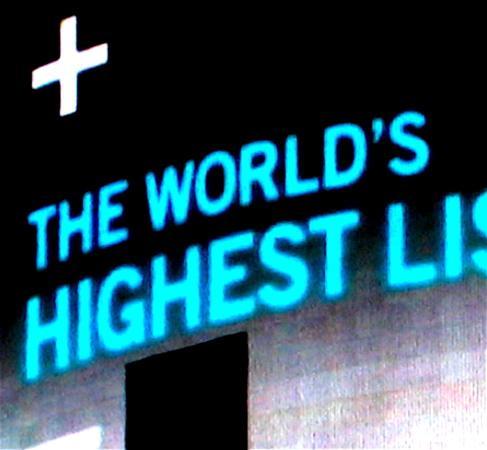 |
|
Image courtesy of Geoffrey Rockwell from Dictionary of
Words in the Wild with permission.
The term "society of the spectacle" comes from Guy Debord, a French intellectual, experimental filmmaker, and participant in a variety of activist organizations that mixed aesthetic innovation and political agitation. Debord was critical of the impact of mass media on everyday life, particularly the ways in which media technologies reinforce consumer capitalism, making it seem both desirable and strangely inevitable. As the prime mover behind one of these groups — the Situationist International (1957-1972) — Debord penned a mission statement "with the deliberate intention of doing harm to spectacular society." That statement, The Society of the Spectacle (1967) or TSS, was described by Le Nouvel Observateur as "the Capital of the new generation." Composed of 221 theses, TSS offered analysis, provocation, and inspiration for the May 1968 uprisings in France.
In it, Debord argues that in societies with modern conditions of production: "all that once was directly lived has become mere representation" (1967/1994, 12). Capital, having attained a critical mass, is enthroned as spectacle — not so much a collection of images as the way in which social relations between people are mediated through images. The spectacle, Jodi Dean remarks, "is a form of social integration presupposing audiences rather than participants" (2004, 270). Consider, for example, the everyday experience of going to the movies, where we sit together in a darkened cinema and partake of what is a shared experience separately. That the spectacle is a primarily visual phenomenon is self-evident; however it is this very quality of obviousness that Debord calls into question by problematizing the link between seeing and being. In his film La société du spectacle (1973), Debord argues that the mystifying power of commodity fetishism is crystallized in spectacle as an "enormous, indisputable and inaccessible positivity," one where "what appears is good, what is good appears." The manifesto of a short-lived, though influential movement, TSS has had an afterlife beyond Debord's original intent of providing the Situationist International with "a book of theory" (Bracken 1997). In addition to a critique of spectacular society, TSS offers a theory for radical practice to transform it. Situationists sought radical change on the plane of daily life through "situations" created by strategies such as détournement or the decontextualization of aesthetic artifacts from their surroundings and accompanying reappropriation for explicitly political purposes (Marcus 1989). Perhaps the most famous example can be found on the cover of the Sex Pistols' album God Save the Queen, where the portrait of Queen Elizabeth is détourned via a motley assortment of typefaces, suggesting a ransom note rather than traditional obeisance. TTS also serves as a prescient critique of globalization, mainly due to Debord's refusal to accept the central premise of the Cold War — that the global conflict between communism and capitalism had created a bipolar world. Debord believed that the relation between communism and capitalism was one of identity rather than antagonism: "in terms of their actual reality as particular sectors, the truth of their particularity resides in the universal system that contains them: in the unique moment that has made the planet its field, capitalism" (La société du spectacle 1973). Both were part of the "universal system" of the spectacle. Revisiting the arguments made in TSS after the collapse of the Berlin Wall and implosion of communist regimes and the Soviet system, Debord argued that the pseudo-rivalries of the Cold War had been superseded by the "integrated" — or globalized — spectacle (1988/1998).
Works Cited:
Bracken, Len. 1997.
Guy Debord — revolutionary. Venice, CA:
Feral House.
Dean, Jodi. 2004. The networked empire: Communicative capitalism and the hope for politics. In Empire's new clothes: Reading Hardt and Negri,
ed. Paul A. Passavant and Jodi Dean,
265-88. New York:
Routledge.
Debord, Guy. 1967/1994. The society of the spectacle,
Trans. Donald Nicholson-Smith,
New York:
Zone Books.
Debord, Guy. 1988/1998. Comments on the society of the spectacle,
Trans. Malcolm Imrie,
New York:
Verso Books.
Marcus, Greil. 1989.
Lipstick traces: A secret history of the twentieth century. Cambridge, MA:
Harvard University Press.