The constant gardener
Belonging
Alina Sajed,
McMaster University
Belonging can be defined as the notion of being part of a
community of individuals or of making something
(particularly a place) one's own. Such a notion, although an
abstract one, can be a weighty one with concrete
ramifications. It evokes several questions: What are those
core elements that are intimately linked to the idea or
action of belonging? Does one experience belonging because
of cultural ties, political ties, or because of social,
religious, or economic ones? Or is it an interesting
combination of all these elements that accounts for
belonging?
Belonging can also be said to be primarily linked with the
notion of the affective — that is, those emotions
that connect us to various people, places, and ideas. This
implies that belonging can be understood by taking into
consideration the emotional links that underpin such an
abstract notion. One feels one belongs to a certain
community because one is emotionally connected to it. In
this light, the processes related to changing borders and
political communities become invested with a particular
relevance. Although physical borders inscribe material
boundaries between states and peoples, it is their affective
character that speaks of the contradictions of belonging.
With the intensification of globalization processes, and
concomitant political implications (such as changing
borders), the senses of belonging that pertain to
individuals and groups are profoundly impacted. The
relationship between loyalty, sentiment, and place needs to
be constantly contextualized and understood in its profound
contingent and historical character. While the nation-state
as a form of political community is only a fairly recent
one, with its artificially constructed borders, such borders
constitute cultural practices as much as they are
constituted by the cultural practices they enclose.
 |
|
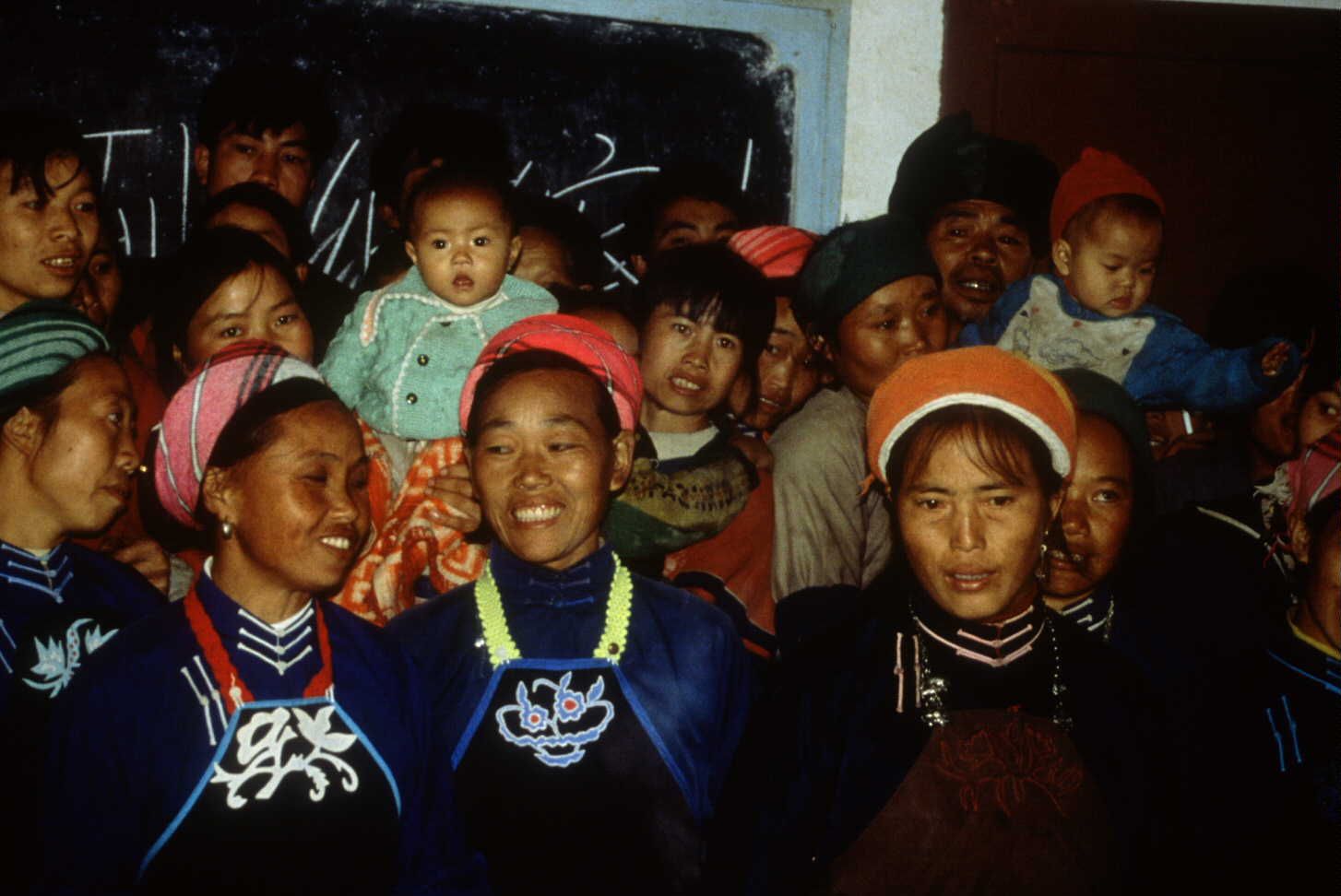
(Photo: Claire Thompson, IDRC-CRDI)
Within the context of today's flows of transnational
migration, belonging becomes a particularly salient issue,
invested with political implications. People who have left
their country tend to organize themselves around that
particular core element — nationality or ethnicity
— in order to recapture their feelings of
belonging. For example, Chinese immigrants might build a
cultural centre or find living quarters near shops that sell
Chinese produce and goods. However, the question of
identification to the "homeland" is a complex one. Such an
issue is not specific to migrants and refugees, but it is a
question with which increasing numbers of individuals and/or
collectivities must grapple, as various forms of political
organization, other than the nation-state, acquire
significance for their lives. For example, with the arrival
on the political scene of the European Union, and its
controversial processes of integration and expansion, the
questions of belonging, loyalty, and placeness become
increasingly salient. Can such an identity as transnational
citizenship be developed and assumed? Is it not that the
very idea of citizenship implicitly (and quite exclusively)
relates identity and loyalty to a particular place and
space, thereby excluding those other layers of
identification that exceed pre-set spatial and cultural
borders, such as issues of gender, sexuality, and class?
In the light of transnational migration flows, the issue of
nationalism becomes an acutely controversial one. There are
heated debates that attempt to answer the question of
whether nationalism is still relevant in an age when
globalization processes are intensifying. Is nationality and
ethnicity an important factor to the idea or action of
belonging? Has it ever been? With the end of the Cold War,
it seemed that such factors had lost some relevance, but the
genocides that took place in the former Yugoslavia,
Rwanda, Congo, and recently the Sudan, have brought new
importance to factors such as nationality and ethnicity.
There seems to be a great intellectual divide between claims
for a continued and strengthened relevance of nationalism
and ethnicity, and those that argue that nationalism and
ethnicity are no longer relevant. The latter voices
prescribe that we ought to transcend our
loyalty to nation/ethnicity, since such an exclusionary
adherence tends to discriminate between those included in
the national community and those outside of it, with the
most devastating consequences.
While scholars from the first camp tend to view the
nation-state as an ahistorical and natural(ized) form of
political organization, those from the second camp tend to
easily overlook the inescapable materiality of the
nation-state and the ways in which this particular form of
organization impacts our lives. For example, historical
legacies associated with the nation-state have come to have
an important bearing on individual and collective senses of
belonging. Various national structures, such as mass
education and the mass-media, construct identities of
individuals as citizens belonging to a certain
space. Such identities become internalized and
naturalized, although they are also subject to contestation.
However, one should not easily claim that one's primary
identity is necessarily a national identity. To put it more
straightforwardly, this implies that one's idea and sense of
belonging to a nation comes not so much from an
identification with the whole nation at once,
rather from an identification to that immediate
community to which one belongs. There seems to be a sense of
immediacy associated with belonging, in as much as one more
easily identifies oneself with immediate spaces, events, and
people.
The ideal of the nation-state as the perfect congruence
between a clearly-cut and uncontested territory and a
homogeneous nation reveals its highly illusory character
with the intensification of globalization processes. The
idea and practice of the nation-state includes many
contradictions and paradoxes, such as the existence of
ethnic communities within its borders that relate to the
nation-state in a richly contradictory manner. With the
simultaneity of globalization and regionalization processes,
certain communities make claims to autonomy, either by their
desire to be separated from the nation-state(s) to which
they were previously subordinated (as in the case of Quebec,
Palestine, the Kurds), or through their claims to
recognition and equal rights (without such claims being
accompanied by desires of separation), such as in the cases
of gay communities, various ethnic communities, various
groups of workers, or certain Indigenous communities.
Although national borders become ever more porous and are
permeated by transnational flows of trade, labour, and ideas
(although still perversely resistant to free flows of
people), the notion of belonging acquires deeper and various
meanings. One can speak of multiple belongings, as in the
case of migrants and refugees. But the idea of multiple
belongings is no longer the lot of those who have left their
homes. Rather, it can safely be attributed to large
categories of people. While being members of particular
nations, people find themselves, at the same time,
emotionally tied to various communities through race,
gender, sexuality, religion, economic position (such as
class), or political orientation. For example, one can
identify oneself at the same time as Russian, woman, Eastern
European, middle-class, heterosexual, Christian Orthodox,
liberal. Such elements, in their simultaneous occurrence,
speak of the individual's belonging to many communities, and
possessing different degrees of loyalty to these
communities.
While senses of belonging and identification have become
more diffuse and more layered, there seems to be a
paradoxical relationship between belonging and autonomy,
when viewed through the prism of globalization processes.
With greater transnational flows of trade, labour, and
ideas, some individuals and/or groups have successfully
claimed autonomy for themselves, as in the cases of certain
categories of women in Western and non-Western countries
(mostly educated individuals with access to the high-skill
labour market). However, for Mexican men and women working
in export processing zones of transnational corporations in
uncertain and miserable conditions, or for certain
Indigenous groups whose very existence is threatened, the
idea of autonomy becomes an everyday challenge and struggle.
As such, it is very much the case that one person's idea of
belonging and autonomy cuts across many of globalization's
tensions and contradictions, thus exposing one of its many
"human consequences," as the philosopher and sociologist
Zygmunt Bauman would have put it.
Suggested Readings:
Balibar, Étienne. 2004.
We, the people of Europe? Reflections on transnational citizenship.
Trans. James Swenson,
Princeton, NJ:
Princeton University Press.
Bauman, Zygmunt. 1998.
Globalization: The human consequences. New York:
Columbia University Press.
Berdahl, Daphne. 1999.
Where the world ended. Re-unification and identity in the German borderland. Berkeley, CA:
University of California Press.
Divakaruni, Chitra Banerjee. 2001.
The unknown errors of our lives. New York:
Anchor Books.