The constant gardener
International Labour Organization
Joanna Langille,
University of Toronto
The International Labour Organization (ILO) promotes social justice through
labour rights. Although presently an agency of the United Nations, it is the sole
surviving organ of the League of Nations, founded in 1919. The ILO formulates
international labour standards in the form of conventions and recommendations
that promote and protect basic labour rights such as the right to organize. Along with standard setting, other ILO activities include research, information sharing, fostering development projects, and providing technical assistance.
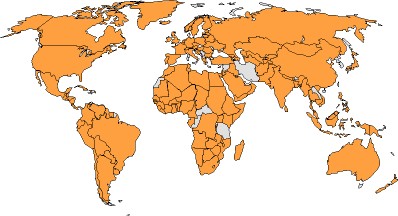 |
| Current ILO Membership |
Growing economic interdependence has prompted many countries to violate social and legal standards in pursuit of economic competitiveness, often resulting in working conditions that compromise workers' rights. In response, the ILO has sought to establish a "fair globalization" by creating the World Commission on the Social Dimensions of Globalization in 2002. This independent commission strives to develop strategies to reduce poverty, foster growth, and encourage social, not simply economic, development. The ILO aspires to ensure that "decent work," a central recommendation in the Commission’s final report in February 2004, is achieved globally. Understood as working conditions that safeguard economic and social livelihood, promoting decent work is a primary ILO objective in a globalizing world.
Founded on the belief that world peace requires social justice, the ILO aims to imbue economic globalization with a social dimension by promoting labour rights worldwide. However, standards can be slow to take effect as the ILO lacks enforcement authority. Moral suasion is its key policy tool. In this respect, its power is considerably less than that of the World Trade Organization, which now has a binding disputes settlement system. In addition, its financial resources and influence are lower than the International Monetary Fund and the World Bank.