The constant gardener
World Trade Organization (WTO)
Anna Lanoszka,
University of Windsor
Mary Pardi,
University of Windsor
The World Trade Organization (WTO) was established on 1 January 1995 by the Marrakesh Agreement, through a lengthy process that began in the Uruguay Round negotiations that produced the Marrakesh Agreement and lasted from 1986 to 1994. The WTO's roots can be traced to the General Agreement on Tariffs and Trade (GATT) where the de facto organization, GATT, dealt with trade of goods. The WTO expanded the role of GATT to cover both trade in services (The General Agreement on Trade in Services — GATS) and trade-related aspects of intellectual property rights (The Agreement on Trade-Related Aspects of Intellectual Property Rights — TRIPS). The WTO's role is to provide technical assistance and training for developing nations, monitor national trade policies, handle disputes, and cooperate with other international organizations. Most importantly, it is a forum for trade negotiations.
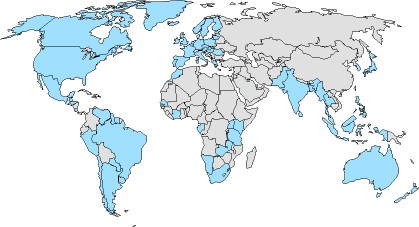 |
| WTO Membership January 1995 |
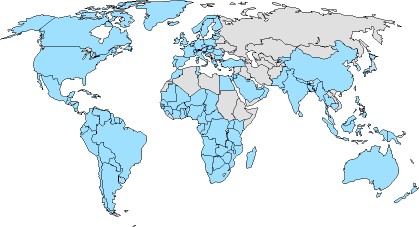 |
| Current WTO Membership |
The WTO had 147 members in 2004 and a Secretariat staff of 600. It is located in Geneva, Switzerland and had a budget of 162 million Swiss francs for the same year. The WTO representative members meet once every two years at the Ministerial Conference. All decisions are made by consensus. The consultation process is, therefore, informal, in order to ensure that all nations come to an agreement. This, however, is sometimes difficult. Nations represent their individual interests in a multilateral system of trade and governance, balancing the needs of the nation with the needs of the World Trade Organization. The WTO has the ability to strongly influence the future economic and political orientation of its member nations and, hence, it has been the target of criticism and opposition by international and domestic non-governmental organizations.
Suggested Readings:
Sampson, Gary P. 2001.
The role of the World Trade Organization in global governance. Tokyo:
United Nations University Press.
World Trade Organization website.
www.wto.org (accessed 22 December 2004).