The constant gardener
International Monetary Fund
Anna Lanoszka,
University of Windsor
Mary Pardi,
University of Windsor
Following the Great Depression, the United States and the United Kingdom, with support from other developed countries, sought to create some new organizations to bring stability to the international monetary and financial systems. At an important conference in Bretton Woods, New Hampshire, they agreed to create an International Monetary Fund (IMF) to seek to stabilize exchange rates, an International Bank for Reconstruction and Development (now known as the World Bank) and an International Trade Organization. The latter organization never came into existence. Originally comprised of forty-five nations, the IMF's current membership includes 184 countries with a staff of 2,690 from 141 nations and is headquartered in Washington, DC.
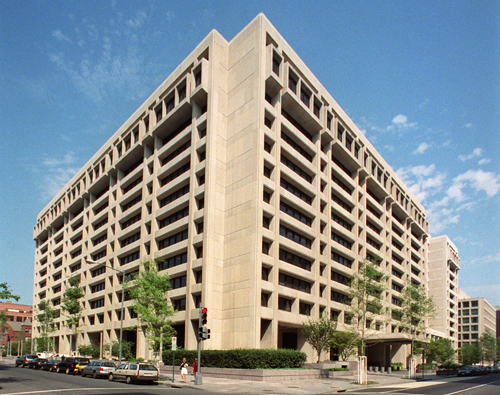 |
| IMF Headquarters in Washington, DC |
(Photo: Free Use Image, Wikipedia)
The IMF funds itself by "quotas" or annual fees paid by each member country. The fees reflect the country's economic size, including its GDP, current account transactions, and official reserves. Quotas play an important role in the IMF decision-making process, as a member's voting power is determined by them. Each member has 250 basic votes, receiving an additional vote for every Special Drawing Right of 100 000 of their quota. The IMF's organizational basis consists of a Board of Governors which has the highest authority. It is headed by a Managing Director, typically a European. Each member nation has a Governor who represents the member country at the IMF-World Bank Annual meetings. Twenty-four members create the International Monetary and Finance Committee, which meets twice a year, with another twenty-four members making up the Executive Board.
The IMF's mission is to promote economic stability by encouraging economic and financial policies that sustain growth. It provides technical assistance, lending, and surveillance to achieve its objectives. IMF staff hold annual consultations with each member nation, examining and offering advice on macroeconomic policies. They help to identify the nations' "strengths, risks and vulnerabilities" and promote good governance in all member countries. The IMF also lends money to countries that are facing economic crisis, but these funds are conditional and temporary. The loan must be paid back on schedule and the borrowing country must correct its balance of payments problem, usually through the adoption of structural adjustment programs.
These structural adjustment programs have been particularly controversial. Beginning in the 1980s, receiving financial support in these programs was made contingent on adopting policies that increased the role of markets and decreased the economic intervention of the state. Privatization, contracting out, balanced budgets, and cutbacks in social programs were encouraged as a means to financial stability. Many developing countries have experienced "globalization" through such programs and would argue that they have suffered important losses of autonomy as a consequence.
Suggested Readings:
International Monetary Fund website.
www.imf.org (accessed 22 June 2005).