The constant gardener
Non-Aligned Movement
Adam Sneyd,
McMaster University
Six years after African and Asian nations condemned colonial and neo-colonial practices at the Bandung Conference, their coalition was formalized in September 1961 at the first Non-Aligned Movement (NAM) Summit held at Belgrade. The twenty-five countries present agreed to not enter into strategic alliances with either the United States or the Soviet Union.
Embracing Indian Prime Minister Nehru's vision for non-alignment, countries in attendance vowed to respect territorial boundaries and to not interfere with, or adopt aggressive postures towards, one another. Leaders such as Yugoslavia's Tito, Indonesia's Sukarno, Ghana's Nkrumah, and Egypt's Nasser believed that the cooperative strategy would give new countries a more powerful voice in global affairs to overcome their economic weaknesses. Although the NAM doubled in size during the 1960s, this voice was muted somewhat as many members accepted financial aid from the superpowers. Nonetheless, the NAM demonstrated its unity through supporting national liberation movements in Africa and seeking a restructuring of the world economy. Its efforts also focused on enabling members to pursue more autonomous paths to interacting with the global economy. At their 1973 Summit meeting in Algiers, the NAM brought its development concerns into a single package of prescriptions for a New International Economic Order (NIEO) and mandated the Group of 77 (G-77) to follow through with this initiative at the UN General Assembly.
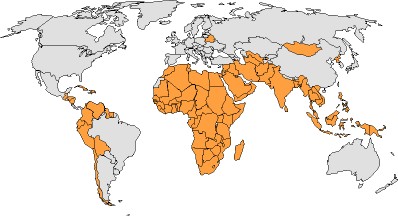 |
| NAM Membership (2005) |
The NAM has remained a uniquely unstructured international organization. It has not adopted a formal constitution and has no permanent secretariat. Decisions are made by consensus at Summit Conferences of Heads of State and Government that occur every three years. Hosts chair the NAM between Summits, coordinating members through day-to-day activities at the United Nations in New York and at Ministerial Conferences.
Many commentators assert that the NAM lost its raison d'être with the end of the Cold War, though it has continued to propound South-South cooperation to advance economic development. South African President Thabo Mbeki, for one, has argued that the NAM remains a relevant forum for the development of common policy positions on poverty eradication, terrorism, and the restructuring of political, economic, and military power. As Cuba takes over the Chair in 2006 it confronts the reality that NAM members represent more than half the world's population, but continue to account for only a small percentage of global economic output.