The constant gardener
United Nations System
Adrian Jones,
McMaster University
The UN system is a complex network of organizations which collectively advance the core purposes of the 1945 UN Charter, including the maintenance of international peace and security, developing friendly relations between states, promoting and protecting human rights, and facilitating economic and social development. These objectives are to be pursued with regard to core principles including the sovereign equality of members, peaceful dispute settlement between members, and non-intervention in matters essentially within the jurisdiction of states.
To organize and coordinate efforts to advance these objectives, the Charter established the following six principal organs and outlines their composition, functions, and powers: General Assembly, Security Council, Economic and Social Council, Trusteeship Council, International Court of Justice, and Secretariat. The General Assembly has ultimate budgetary authority, and apportions the expenses of the UN system among the members. The scale of assessments is based primarily upon members' capacity to pay.
The Charter also provides for the establishment of subsidiary organs, as necessary. These have proliferated in number and functional scope since 1945: Subsidiary Bodies (e.g., Peacekeeping Operations and Missions); Specialized Agencies (e.g., World Health Organization, International Bank for Reconstruction and Development, International Monetary Fund); Functional Commissions (e.g., Human Rights, Sustainable Development, Status of Women); Programs and Funds (e.g., UN Children's Fund, UN Development Program, World Food Program); Departments and Offices of the Secretariat (e.g., Legal Affairs, Management, Public Information); Regional Commissions; Research and Training Institutes; and Other UN Entities (e.g. Joint United Nations Program on HIV/AIDS). Though these bodies address specific global policy challenges and they possess varying degrees of operational independence, their mandates are inherently complementary to one another and consistent with the overarching UN objectives outlined above. The UN system also has formal relationships with such bodies as the World Trade Organization, the Organization for the Prohibition of Chemical Weapons, and the International Criminal Court. An organization chart of the United Nations system can be found at: www.un.org/aboutun/unchart.pdf
Largely stemming from formal decolonization, and the fragmentation of the former Soviet Union, UN membership has almost quadrupled from fifty-one in 1945 to 191 in 2004. Member-states have equal voting rights within the General Assembly, the UN's central deliberative body. Though tensions exist between developing states and developed states concerning the precise meaning, relative priority, and specific approaches to be taken in addressing certain core issues, it is increasingly recognized that all of the UN system's goals are fundamentally interlinked. Thus, Secretary-General Kofi Annan has resolved to "improve strategic planning, promote coherent policy development, and to encourage analysis of the linkages among the political, economic, developmental, humanitarian, and security issues confronting the Organization" (United Nations General Assembly 2002, Section IV Para. 114).
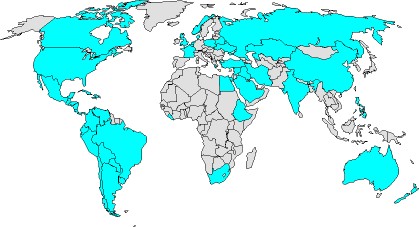 |
| United Nations Membership in 1945-46 |
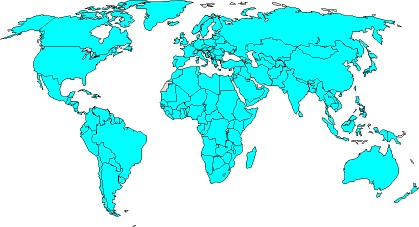 |
| Current United Nations Membership |
The UN system may provide a working model toward what may eventually become a global government. At present, it essentially remains an inter-governmental organization of sovereign states. In other words, states collaborate and coordinate activities and initiatives, and delegate a wide range of tasks and responsibilities to UN bodies, but they have not ceded their ultimate legal authority over their respective territories and populations. Nonetheless, the UN system is perhaps the most comprehensive global governance framework in existence.
The UN system is frequently criticized for being subject to political influences. In part, such perceptions stem from the relatively high profile of the General Assembly and Security Council, which tend to receive greater media publicity. However, these may be seen as valuable forums for international debate with reference to the generally accepted rules and legal principles of the Charter. To some extent, the diversity of values and interests brought to bear by member states within the UN system are bound to give rise to political controversies, and discussing such issues within a structured environment is certainly preferable to armed conflict. Moreover, appraisals of the UN system's overall effectiveness should have regard for the vast range of important work undertaken by its less visible bodies which address many of the most immediate issues of globalization and autonomy: health and nutrition, economic development, environmental protection, human rights, education, nuclear non-proliferation, financial stability, conflict prevention, technology, and emergency relief from natural disasters.
The UN system has also been criticized for being unrepresentative of the world as a whole. Most obviously, the Security Council is composed of fifteen members, ten of which serve two-year terms, but five of which hold permanent seats (Britain, China, France, Russia, and the United States). Each of these five members may veto any collective decision of the Security Council, which has arguably prevented the Security Council from consistently and effectively fulfilling its primary responsibility for matters of international peace and security. Even within the General Assembly, which provides observer status for accredited individuals and officials of non-member states, formal membership and voting entitlements are restricted to states. Critics argue that state officials do not, or cannot, fairly represent the diversity of views and needs of individuals and groups within their states. Some proposals for democratization of the UN system involve the creation of a directly-elected second assembly. More modest proposals seek to make the UN system more transparent, accessible, and accountable to global civil society and the global public in general. There is also broad agreement that the UN system must become more cost-efficient in its various operations.
The practical difficulties of substantive reform itself are an additional area of concern. Formal amendments to the Charter require the approval and domestic ratification of a two-thirds majority of the General Assembly, including all five members of the Security Council. This procedure makes proposed amendments very difficult, particularly those which would alter the composition of the Security Council itself. However, the 2004 Report, A More Secure World: Our Shared Responsibility, reflects pro-reform sentiments which continue to gain momentum in the midst of conventional and novel threats to individual human security and autonomy.
Finally, it is important to consider the extent to which the UN system has progressively evolved without formal Charter amendments. For example, as the most representative organ, the General Assembly has gained increasing legitimacy as perhaps the foremost authoritative body of the UN system. Though its resolutions are technically non-binding under international law, they provide important frames of reference for legal and policy discussions within and outside the UN system It has also been suggested that the International Court of Justice could extend its role beyond pronouncing upon inter-state disputes and providing advisory opinions, to include judicial review of actions or inactions of UN bodies which contravene the Charter.
Works Cited:
United Nations General Assembly. 2002.
Strengthening of the United Nations: An agenda for further change. Report of the Secretary-General. Geneva:
United Nations.
Suggested Readings:
Hampson, Fen Osler and David M. Malone. eds. 2002.
From reaction to conflict prevention: Opportunities for the UN system. Boulder, CO:
Lynne Rienner.
Krasno, Jean E. ed. 2004.
The United Nations: Confronting the challenges of a global society. Boulder, CO:
Lynne Rienner.
Mingst, Karen A. and Margaret P. Karns. 2000.
The United Nations in the post-cold war era. 2nd ed.
Boulder, CO:
Westview Press.
Price, Richard and Mark W. Zacher. eds. 2004.
The United Nations and global security. Basingstoke, UK:
Palgrave Macmillan.
United Nations website.
A more secure world: Our shared responsibility. Report of the High-Level Panel on Threats, Challenges and Change,
www.un.org/secureworld (accessed 31 May 2005).
White, Nigel D. 2002.
The United Nations system: Towards international justice. Boulder, CO:
Lynne Rienner Publishers.