The constant gardener
Budapest, Hungary
Justin Armstrong,
McMaster University
During the fall of 1989, a rash of changes swept over Eastern Europe as the Iron Curtain began to rise. One of the most significant locations for this phenomenon was the Hungarian capital of Budapest. Chief among the reforms of 1989 was the opening up of the Hungarian-Austrian border, a move that allowed over 12,000 East Germans to travel freely to West Germany via Hungary, an event that reflected a meeting of the ideas of globalization (the dissolution of borders) and autonomy (the desire for governments to keep their populations under explicit state control) in one location. In an attempt to halt this mass exodus of East Germans through Hungary, East German leader Erich Honecker lobbied Soviet prime minister, Mikhail Gorbachev to send troops to aid in maintaining the East German border. This request fell on deaf ears and no Soviet aid ever materialized. Only weeks later, the Berlin Wall was torn down. By the end of the year, all of the Eastern European communist regimes had fallen in a rapid chain-reaction of revolution. Besides the geo-political pressure it had exerted on East Germany, Hungary (and specifically Budapest) was one of the most likely locations for the dissolution of state socialism in Eastern Europe for a number of reasons.
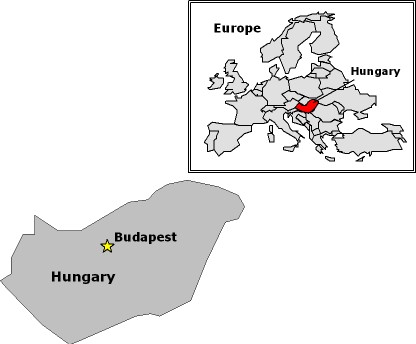 |
| Figure 1 |
Hungary had been following a gradual path of socio-economic reform that began as early as 1953 and continued through the 1980s with allowances for small private business, increases in the availability of consumer goods and talks of leaving the Warsaw Pact union of Eastern Bloc countries. The opening of the Hungarian-Austrian border proved a critical juncture, along with the "re-funeral" ceremonies, the same year, for one-time prime minister and reformer, Imre Nagy (executed for crimes against the state in 1958). This celebration and reburial of a personage, who many believed had begun to sow the seeds of reform decades before, signified the rebirth of a new, more liberal Hungary. After several years of uncertain policies and governmental inequities, it had become evident that the state apparatus had become morally bankrupt and increasingly fragile.
Finally, the spread of international media signals in the late 70s and through the 80s allowed Hungarians to see and hear news and information from the rest of the world — a development that soon laid waste to the state-sanctioned popular memory supported by the media and educational institutions. The influx of new ideas and images from abroad acted as one of the key factors in developing a Hungarian desire for a more globalized existence; Hungary wanted to be a part of what was happening outside of its borders and this was reflected in popular opinions toward the state. A more globalized understanding of their place in the world, coupled with ideas of the possibility for reform and changing economic tides in the Soviet Union and elsewhere, led Hungarians to re-examine the way in which their country was being run and eventually bring about free elections 1990. More recently, Hungary has made moves to become a more influential and active member of the global community through membership in NATO (1999) and the European Union (2004), as well as by borrowing from the World Bank for development and modernization projects (US $4198.3 million to date). Hungary — and in particular, Budapest — has also seen US $23 million dollars in foreign investment since 1989, a definite indicator of its eagerness to participate in the world market. In this way, Hungary (and specifically Budapest) represents the beginning of the end for the cohesion and power of the Eastern Bloc; it was the social, economic, and political "tipping point" that eventually resulted in the end of state socialism in Eastern Europe and a move toward global awareness.