The constant gardener
The Hague, Netherlands
Adrian Jones,
McMaster University
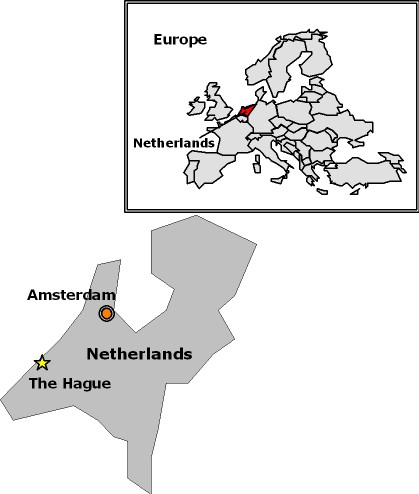
The Hague Netherlands, has become a global centre of international law, justice, and peace. Its stature as such derives in part from its geographically central location within Europe, where much of contemporary international law originated, as well as from the historical diplomatic reputation of The Netherlands. Having had a great deal at stake with respect to peace and stability in Europe, The Netherlands also has been eager to host international legal conferences and institutions.
 |
| Figure 1 |
The Hague has hosted historic conferences facilitating the development of international law to promote peaceful dispute settlement between states, and address other aspects of justice and security. Among these were the 1899 and 1907 Hague Peace Conferences initiated by Czar Nicholas II of Russia, and which resulted in the first comprehensive codification of international humanitarian law preceding the 1949 Geneva Conventions. It now hosts several international judicial bodies: the United Nations International Court of Justice and Permanent Court of Arbitration; the International Criminal Court; and the International Criminal Tribunal for the former Yugoslavia, which was the site of the trial of Slobodan Milosevic, the first head of state to be prosecuted for international criminal atrocities.
The Hague also fulfills a symbolic role for international peace and justice, exemplified by the magnificent Peace Palace, site of the International Court of Justice and Permanent Court of Arbitration. It contains numerous artifacts donated from states as gestures of peace and goodwill. In 2002, an eternally burning World Peace Flame was installed in front of the Peace Palace. Two years later, the flame was encircled by a World Peace Pathway. The latter was established as a demonstration of international solidarity; every state in the world donated stones representing their respective cultural heritages.
As globalization entails an increasing global ethic of collective and individual responsibility, the connotations of peace, justice, and security have correspondingly evolved. The judicial institutions at The Hague reflect such global concerns as international peace and security, human rights and security, and international criminal justice. These bear upon core questions of individual and collective autonomy, which are significantly dependent upon the international rule of law for their observance and protection within established and evolving modes of global governance.
Suggested Readings:
Eyffinger, Arthur. 2003.
The Hague: International centre of justice and peace. The Hague:
Jongbloed Law Booksellers.
The Hague Legal Capital website.
www.thehaguelegalcapital.nl (accessed 2 March 2005).
The Hague Municipality website.
www.thehague.nl (accessed 2 March 2005).
The World Peace Flame website.
www.worldpeaceflame.com (accessed 2 March 2005).