The constant gardener
Cajamarca
John Weaver,
McMaster University
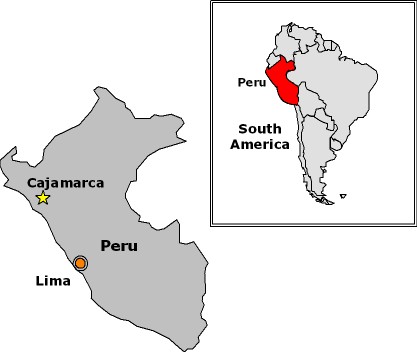
In a globalizing world, small places remote from centres of power can be profoundly affected by distant decisions and desires. This is not entirely new. However, until relatively recently, continuous contacts among civilizations had mainly been established and sustained in order to secure and move high value articles. For many centuries gold, for example, has retained a special allure in many parts of the world. It was one of a handful of prized articles — spices, furs, and silks were others — that drew European adventurers from the 1500s to the 1700s to what they perceived as the far corners of the globe. Today, the town of Cajamarca, in a valley in northern Peru, stands witness to a long history of changes effected by a pursuit of gold. The town is an allegory for the more disruptive events of globalization.
 |
| Figure 1 |
One of the world's largest and most profitable gold mines currently lies north of Cajamarca. The type of mining undertaken at nearby Yanacocha contrasts with the famous gold mines of South Africa which now are thousands of metres deep and observable on the surface by their mounds of tailings. There are no mine shafts at Yanacocha. Rock is quarried, trucked to terraces, and soaked in a cyanide solution. Cajamarca has prospered as a consequence of multi-national mining giants. The town boasts pubs and discos, but the lack of employees' benefits, scale of excavations, and concerns about water quality have animated local activists and international environmental groups (The Economist 5 February 2005). The resulting conflicts produce and expose conundrums, because mining is a major source of regional employment, taxes for Cajamarca, and revenue for Peru.
Confrontations in and near Cajamarca will be significant. They may result in more local control and more responsible mining practices. Short- and long-term historical perspectives, however, remind us not to expect either benign local or global influences. Mining companies, including state-owned ones, have long been dumping toxic waste in the Andes. Governments in the Andes have been corrupt or dysfunctional. Arresting too is the fact that greed, interlopers from another civilization, and betrayal were mixed into a sequence of events at Cajamarca as early as 1532. Not far from the town square, Spanish conquistadors imprisoned the Inca ruler Atahualpa (also spelled Atahullapa) until he provided a ransom in gold. The story of his capture encapsulates a substantial trend in the history of the Spanish conquests in America.
On 16 November 1532, one of the most dramatic episodes in the relations of European and native American civilizations took place. Francisco Pizarro with 168 soldiers defeated Atahualpa, leader of the Incas, the largest and most organized society in the New World. Explanations for the defeat of a vastly larger Inca force — perhaps 80,000 — inform us about the European impact on the New World in the decades after the landings of Christopher Columbus on Caribbean islands in 1492. The Inca court in 1526 had been devastated by a smallpox epidemic. With the Spaniards came diseases — smallpox, but also measles, influenza, typhus, and bubonic plague — endemic to Europe but not necessarily present in the New World. The epidemic at the Inca court led to a civil war; Atahualpa was returning from a victory over a rival when he encountered Pizarro. In the reconquest of the Iberian peninsula from Islam which concluded in 1492, Spaniards called upon Muslims to surrender and accept Christianity (the requerimiento); if they did not, war ensued. Spaniards made identical bitter offers to indigenous peoples in the New World. Atahualpa refused, and was soon captured by soldiers with firearms, steel weapons, and horses. In keeping with Inca custom, he offered to pay a ransom, but Europeans had not come simply to plunder, but to stay. Atahualpa paid the ransom, but his captors murdered him.
The transfer of Eurasian biota - exemplified by diseases and horses at Cajamarca - was a significant step in global integration, and the conquest of the Inca Empire put Europeans in command of a pre-established empire and social system. At first, the new rulers extracted wealth from Inca systems of tribute, but the discovery of silver in Peru and Mexico, home of the Aztec empire, revolutionized the young Spanish empire. Silver provided liquidity for the European economy, and for the Chinese economy by way of Manila. Silver mined in the conquered New World became a global trade commodity. Today, gold attracts outsiders to the Andes, as it had initially, but this time the quest is changing the landscape and provoking local as well as international resistance.
Suggested Readings:
Diamond, Jared. 1997. Collision at Cajamarca. In
Guns, germs, and steel: The fates of human societies. 67-81. New York:
W. W. Norton.