The constant gardener
Shanghai
Imre Szeman,
McMaster University
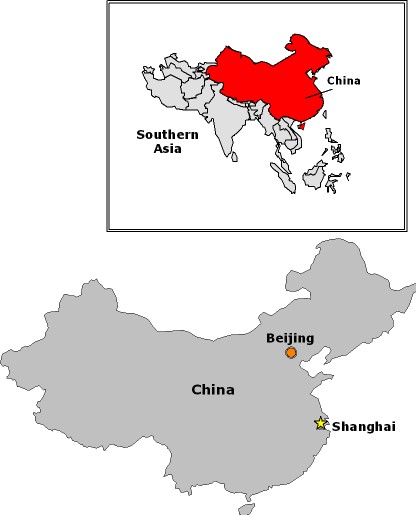
The space age, postmodern skyline of Shanghai's Pudong district has become an iconic symbol not only of China's entry into the global capitalist economy, but of globalization itself. Shanghai is the most populous and densest city in China, and one of the five most populous cities in the world. (In 2002, 16.25 million people lived in the city and ten million in the metro area.) Even after the return of Hong Kong to China in 1997, Shanghai has once again become the financial hub of China and is one of the major financial and economic centres in all of Asia, rivaling Singapore and Tokyo.
 |
| Figure 1 |
Shanghai's development into a major global city was spurred in the early to mid-nineteenth century, when it emerged as a major trading port with the West. The Treaty of Nanjing (1842), which marked the end of the First Opium War between Britain and China, established Shanghai as one of the Chinese treaty ports and paved the way for both foreign (primarily American and British) business and settlements to set up in the city. By the end of the nineteenth century, the city had become the financial hub of the Far East, a position it held until the Battle of Shanghai in 1937. An essentially "open" city in the 1920s and 30s (no visa was required to enter Shanghai), this period of the city's history has become immortalized in fiction and cinema as a place of bohemian lawlessness (e.g., as depicted in the movie Indiana Jones and the Temple of Doom and, more recently, Kung Fu Hustle).
During World War II, Shanghai was open to refugees from war, including Jews fleeing from Nazi Germany. Japanese Occupation of Shanghai between 1937-1945, followed by the Communist takeover of China in 1949, led to the relocation of most foreign firms to Hong Kong. In the Communist-era, Shanghai has remained an important economic and political centre, though until recently capital flight and strict controls by a government suspicious of its Westernized culture caused it to fall behind other Asian cities. In 1992, economic reforms were enacted by the government to encourage investment (foreign and domestic) in Shanghai. For the past decade, annual economic growth in Shanghai has measured an astonishing nine to 15 percent and the rate of skyscraper construction has led many to estimate that 20 percent of the world's construction cranes have taken up residence in the city. For many, the city's recent development has come to be an index of both the problems (e.g., the environmental impact of Chinese modernization) and possibilities (e.g., the emergence of new middle classes) of globalization.