Globalization, Power and Authority. The Emergence of New Connectivities
Ulf Hedetoft, Aalborg University
Preface
Ulf Hedetoft is Professor of International Studies and Director of The Academy for Migration Studies in Denmark (AMID).
This paper was presented at the Fourth MCRI Globalization and Autonomy Team Meeting at the Munk Centre for International
Studies, University of Toronto, 23-25 September 2005.
Globalization, Power and Authority
Globalization can be viewed as a set of processes that derives from, but also transcends, the parameters on which
nation-states and internationality are constructed. Such a view challenges the way in which structures of power and
authority are configured in a Westphalian, state-centric perspective, as deriving from inside state borders and from the
international interaction of states (Beck 2000; Scholte 2003; Strange 1996). For most nation-states and international
institutions constructed around principles of egalitarianism and symmetrical interdependence, globalization implies less
financial control, more political vulnerability, increased levels of (inter)dependence, new supraterritorial processes,
and transnational networks. It also entails more pronounced hierarchies of power and new political cleavages between
binary properties of state and government that, in an ideal way, belong closely together. One of these is the nexus
between power and authority.
I concur with David Held and his colleagues (1999) who argue that globalization transforms "the spatial organization of
social relations and transactions" and with Michael Cox's (1994) insistence that globalization makes "states into agencies
of the globalizing world," rather than vice versa. As I have argued in earlier writings (Hedetoft 2003; 2004), a
distinguishing feature of this global order is that even reactive forms of anti-globalizing measures need to take account
of and often, despite their outspoken intentions, end up strengthening globalization. It should be added that
globalization is not, and certainly no longer can be viewed as, merely the outgrowth of the invisible hand of the
marketplace, of economic forces and financial flows. It is an increasingly controlled and politically engineered process
of neo-imperial design and concomitant power struggles intended to control, constrain, and give direction to the ever more
intense and multiple transborder dynamics which we rightly dub globalization. These processes deeply affect forms and
substances connected with power, authority, legitimacy, and sovereignty (Grande and Pauly 2005; Hedetoft forthcominga;
Wade 2003).
The important implication is that globalization, though undoubtedly a challenge to states, does not point us in the
direction of a single world without states, without political borders, and devoid of national interests. Rather, it
creates a new political, technological, and economic environment for state behaviour, a new set of power relations, and a
new division of labour, within which states — according to the resources, influence, traditions, autonomy, and
adaptability that they can muster — are left to cope as best they can (Baylis and Smith 1997; Gray 1999; Held et
al. 1999). In some cases, particularly developing countries, this is a negative experience of increasing inequality,
poverty, or even bankruptcy. Many other states will learn to adapt (possibly benefit) or to cooperate along new lines
(e.g., regionally or by means of new competitive parameters), while the most powerful — the makers and
beneficiaries of globalization (whether state or non-state actors) — face a potential win-win situation (Campbell
et al. forthcoming; Mittelman 2000; Williamson 1990).
Although globalization may well, in the long run, tend toward singularity and (more) global homogeneity, it is significant
to recognize that states are positioned differentially in the global context. Globalization, therefore, has different
consequences and implications for different actors, according to whether they are weak or strong, big or small, rich or
poor, how they are positioned relative to the global centers of political and economic gravity, how much weight they are
able to pull in pivotal international institutions, and how adequate and innovative state and corporate strategies are for
dealing with global challenges (Hirst and Thompson 1996). Eduard Ponarin frames Russia in this context, stating that
"[w]hile European countries associate globalization with good economic prospects, military security, and other advantages
that may induce even the French to swallow the burger, Russians associate pro-western reforms with economic hardship and
Russia's loss of global prestige" (Ponarin 1999, 3). Globalization from this prevalent Russian perspective, is clearly
associated with a loss of power and international authority (Blum forthcoming; McAuley 1997). Ponarin's equation of
globalization and Western political strategies, however, overlooks that Western states are themselves affected
differently, and not always positively by global forces.
More often than not, such normative assessments, strategies of accommodation, and consequent outcomes are deeply embedded
in the way they have been determined, shaped, or at least coloured by historical developments, (dis)continuities, and
relations — both domestic and external, and both regarding the longue durée and more recent
history (Hopkins 2002).
The model proposed in Figure 1 tries to take account of the most salient of these multiple factors of globalization. It
rests on the assumption that key aspects of global pressures and reactive forms, and thus of the dynamics of power and
authority, can be identified by analyzing reflexive relations between globalization and four national "nodes":
sovereignty, mass/elite interaction, political history/collective identity, and security and threat scenarios. The four
nodes can hardly be disputed as being at the core of national self-images and perceptions of independence, though it might
be argued that they are not exhaustive. Even so, they — and their mutual and multiple inter-linkages —
provide a useful matrix for delineating the major challenges that globalization represents to contemporary statehood and
attendant structures of power and authority.
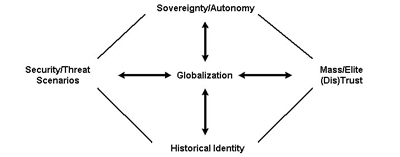 |
| Figure 1: Globalization and the Dynamics of Power and Authority |
Starting from the top, the most immediate victim of globalization is sovereignty. "Ultimate control" of the "state of
exception" (Schmitt 1932/1996) is made increasingly difficult by transnational flows of money, capital, goods, and (to a
more limited extent) people. Institutionalized legal or normative regimes of rights and values come into conflict with the
exclusive authority of states within their own (no longer so) secure borders. Financial, technological, natural, and
political resources on which sovereignty is predicated increasingly elude most states, which find themselves embroiled in
ever more committal and ineluctable networks of (often regional) collaboration in order to cushion the blows of global
pressures — the EU being a prime case in point (Grande and Pauly 2005; Hedetoft forthcomingb).
The levels and depths of what John Tomlinson has termed "complex connectivity" have reached a point where de jure and de
facto sovereignty increasingly part ways, and where, in some cases, sovereignty is no longer an operative feature of
nation-states Instead, nation-states have to look for new avenues of influence, autonomous spaces of manoeuvre and
collaboration,1 and novel forms of governance (rather than traditional government) in order to pursue policy
preferences that constantly need to adapt to, constrain, or benefit from an ever more present globalizing context.
National interests and national sovereignty, but also power and authority, tend to become divorced from each other in this
process. This is the case most acutely for small, weak, or vulnerable states, or states facing serious changes of
international standing and recognition. On the other hand, more powerful states, notably the United States, are able to
proactively impact, even engineer, globalization to match national preferences (Hedetoft forthcominga; Foot et al 2003;
Wade 2003). Political globalization, therefore, is not an anonymous, almost invisible process beyond political control. It
is increasingly an institutionally orchestrated and designed configuration of forces shifting the symmetrical structure of
the international order toward asymmetry and hierarchy, distributing benefits and drawbacks unevenly, subdividing the
world into weak and strong more clearly than before, and hence re-ordering the landscape of power in fundamental ways.
Forms of dependence for some contrast with degrees of independence for others. Where many states have to seek compensation
for the loss of sovereignty in new forms of autonomy, others find their sovereignty as well as their projected external
power reinforced by globalization. This does not imply that globalization is necessarily a drawback for smaller and
medium-sized states. They can certainly benefit, but whether they do so or not depends on minutiae of strategic adaptation
to global centrifugal forces, over which they have little control (Campbell et al 2006; Cohen and Clarkson 2004;
Katzenstein 1985).
Moving clockwise on the model, globalization threatens to intervene in the elite/mass nexus by producing increased levels
and new forms of disaggregation and distrust between the two components, which cut both ways. Clearly, however, this
depends on the forms of globalization that are most relevant to different states, on the modalities of trust or distrust
preceding the "intervention" of global pressures, and on the forms of governance chosen by political leaderships in order
to cope with globalization — choices invariably linked to the status of particular states in the international
order. In general terms, however, the disaggregating effect of globalization pertains to the transformation process of
traditional sovereignty discussed above. The more sovereignty and political control at the national level are diminished
and constrained, the more political preferences and forms of collaboration at the elite level will be oriented toward
transnational thinking and practices. The real scope for political choices by democratic national citizenries at the
domestic level will also be narrowed. This tends to affect structures of authority in multiple ways. In terms of
ontological security, it means that the trust electorates might place in elected leaders will be counteracted by the ever
more conspicuous dependence of these leaders on global (i.e., extra- and supra-territorial) flows and decision-making
structures in the fields of trade regulation, international security, migration control, or human rights. Leaders' increasingly active participation in such transnational processes may also diminish this trust. Thus, the real or imagined
feelings of living within secure, ordered, and separate national universes will tend to dwindle, and popular
disenchantment with elites will tend to increase. Conversely, if trust and political confidence were already moderate
before the global turn, these novel developments can add extra fuel to such sentiments.
On the other hand, the very same developments give rise to crucial forms of political reaction too — reactions
which aim either to maintain the compact between government and population or to forge new, global signifiers of loyalty
and identity, inter alia in the form of global (or regional) democratic practices and norms. The possible
consequence of both these options is the creation of new horizontal cleavages, at the popular as well as elite levels,
and, on aggregate, the uneasy co-existence of new (global), moderate (liberal), and traditional (nationally conservative)
politics.
The most significant manifestation of these options is the flourishing of anti-globalizing, anti-immigrant populism where
political actors deploy discourses of national cohesion, negative images of "the Other," historical myths of ethnic
homogeneity, cultural interpretations of borders and sovereignty, and possibly policies of more or less radical ethnic
purification as well. These political strategies often target disaffected and marginalized sections of populations, or at
least sections that associate globalization not with new opportunities, but rather with a series of threats (to welfare,
jobs, security, or culture). At the same time they will attempt to link traditional political leadership with suspect,
non-national motives, or with sheer incompetence. The effect of both is neglect of the true interests and desires of the
people. The prime object of such nationalist animosity — and evidence that political leaders have let the people
down — is immigrants and refugees from Third World countries, who are visible, poor, often dependent on welfare
benefits, and culturally different from "us." The immigration field has become a pivotal point for the symbolic politics
of sceptical, sometimes quite ferocious anti-global sentiments and identity politics attempting to remedy a mass/elite
nexus that is perceived to be falling apart at the seams and undermining a tight nexus between political authority and
state sovereignty (Betz 1994; Hedetoft forthcomingc; Laclau 2005). Whether or not such political strategies are
successful — or to what degree — significantly depends on the context of political history and
collective identity in individual countries. This is the third node of the model.
The dialectics between globalization and collective historical identity are anything but simple. If historical identity
implies a confident political as well as cultural sense of homogeneity and solidarity — in other words, if we are
talking about a "thick" sense of national identity — the challenges of globalization to sovereignty, territorial
integrity, and democratic accountability can be offset or deflected by culturally and historically rooted sentiments of
unity and the belief in future cohesion that these may trigger. This will particularly apply if states, even smaller and
more vulnerable ones, are used to acting in and adapting to changing international circumstances, and if the continuity
of historical identity is complemented by a tradition of accommodating and integrating differences. If, on the other hand,
we are dealing with "thinner" forms of national identity, which have struggled to achieve cohesion and have been subjected
to extensive social and political engineering in order to reach this goal (however temporarily), globalization may impinge
in much more disruptive ways, opening old wounds and triggering new conflicts. The same happens where ethnic pluralism
does not go "naturally" hand in hand with a sense of normative unity and political consensus, where multicultural
strategies have been obscured by the imperial/colonial history of the state or have proved abortive/problematic for other
reasons, and where the mass/elite nexus is tenuous.
In these (empirically often very different) cases, globalization may be perceived to represent a threat to domestic order,
social welfare, or national security. The effects of such insecurity scenarios, however, are much less uniform.
Globalization may lead to social and cultural cleavages and to eroding or contested forms of authority. But, as discussed
above, it may also lead to a new sense of unity, however short-lived, of either civic purpose (forward-looking —
as in China) or ethnic myth (backward-looking — as in Russia). This unpredictability of effects and consequences
also relates to the first, confident modality of "thick" national identity. In some cases this modality may negate itself
and produce new divisions, more national scepticism and less consensus, if complacency or paranoid interpretations of
global vulnerability stand in the way of a realistic assessment, and hence successful outcomes, of the threats and
opportunities embedded in globalization. This in turn depends heavily on the perceptions of national security and the
specific threat scenarios which are pervasive and agenda-setting in the public sphere — in other words, on the
fourth node of the model.
Globalization is a major challenge to perceptions of national security connected to tight borders, territorial
sovereignty, and independent defence capabilities — but also to vaguer notions of societal or human security and
its implications of cultural well-being, ontological belonging, and political welfare. In this sense, the fourth node and
its interface with global processes comprise the other three forms of dialectical tensions as well: security depends on
sovereignty, on close mass/elite interaction, and on a perceived sense of historical identity. It straddles high as well
as low, foreign as well as domestic politics, while at the same time resting on a foundation of self/other dichotomies, on
certain perceptions of threat. This is not because globalization is the wellspring of threats and dichotomization, which
are inherent in normal interstate relations. The interesting contribution of globalization is that it produces new threat
scenarios by overriding or eroding some of the old interstate dichotomies — the familiar structure
of uncertainty and threat on which discursive authority and political power are traditionally constructed. Since this kind
of security is premised on the existence, but also on the political containment of "symmetrical" threats, the perceived
new threats of globalization, somewhat perversely perhaps, consist in producing an environment that is seen to be
unpredictable and in that sense uncertain rather than in producing indisputable dangers. It engenders "risks," in Ulrich
Beck's (2000) and Mary Douglas' (1994) terminology, largely because it promises to eliminate old hazards, enemies,
boundaries, and battle lines, replacing them with the "asymmetrical" Unknown of ethnic and cultural mixing, transborder
economic flows, global communication, civilizational encounters, supranational hegemonies, Islamic extremism, natural
disasters, and much more which people more or less indiscriminately associate with globalization.
These new insecurity scenarios are related to the endeavours of states to maintain themselves as discrete political and
cultural units in circumstances that in many ways privilege a different mode of interaction than the traditional
interstate system. This implies numerous reactions to globalization, as many as there are states, and as varied as their
mutual differences dictate or facilitate (in terms of power, size, resources, composition, international integration,
structure of the economy, or geo-political position).Whether to hem it in (new border controls), adapt flexibly to it
(welfare strategies combined with liberal economics), redesign its flows (neo-imperial policies), or institutionalize it
(managing the flows of people, capital, and commodities), states take advantage, in different ways, of the opportunities
globalization offers while minimizing risks and maintaining core aspects of the familiar dichotomies of yore. By thus
interpreting globalization in terms of threats and risk, globalization itself is impacted and given a certain structure
and direction, but so is the structure of power. "Threats" and traditional security face the "risks" of border erosion and
power diffusion. On the macro-scene of the new global context, this is complemented by the opposition between the reality
of permanent, asymmetrical warfare and the promises of a new version of "hegemonic stability," when the world, we are
meant to believe, has been thoroughly democratized.
Power and authority structures are thus impacted both in terms of the interaction between each of the four nodes and
globalization, as well as the multiple ways that these four nodes connect with and impact each other. For instance, the
transformation of sovereignty is important for popular distrust of political elites, but also for new risk scenarios and
security agendas. Historical identity co-determines to a large extent if and how the authority of states and political
actors may be maintained in the age of global pressures. It also impinges on new formulations of sovereignty and autonomy.
Mass/elite trust or distrust is crucial for possibilities for, or obstacles to, accommodating more open borders, accepting
new risks, and channelling new pressures into new opportunities.
It was hinted above that, like relations between identity and interest, or populations and elected leaders, the two tend
to become disjointed, one from the other, in this era of totalizing globalization. We now find multiple sites and processes
characterized by power with contested, diminishing, or little authority and, conversely, authority with contested,
diminishing, or little power. Examples of the former would be neo-imperial structures (pre-emptive intervention;
Guantanamo); transnational networks of lobbyism, informal governance, or terrorism; international regimes and global
institutions like the G8, the World Bank, and the International Organization for Migration; and private agencies vested
with considerable power but little legitimate authority (global accountancy firms, investment banks, transnational
corporations, or flight carriers in the area of "remote" migration control). Examples of the latter — authority
without power — are small nation-states in areas like security, trade regulation, or migration flows; certain
religious institutions and leaders (Muslim Imams in Europe, or (former) state churches in Scandinavia); charismatic public
personalities (for instance, from the worlds of entertainment, sport, or fiction); and numerous NGOs, advocacy networks,
and international institutions (Amnesty International, the International Criminal Court, or the European Court of Human
Rights).
These examples are evidence of institutional disaggregations of power and authority attendant on globalization and its
infringement of the national compact between these two components of statecraft and governmentality. The outcomes are
varied and lend themselves to different normative assessments, but they are certainly far from simple or one-sided. While
sometimes undermining or eroding state legitimacy and questioning many taken for granted assumptions about the structure
of political life, these processes also open up, in the interstices, a political and cultural space for evolving substate
autonomies, for the reclamation of transnational action by individuals and collectivities, and for the potential
empowerment of marginalized groups (Mathews 1997). At the same time, we should not be blind to emerging reconnections of
power and authority at the supranational and supraterritorial level, as evidenced by institutional developments in the
European Union, by the NATO interventions in Kosovo and Afghanistan, by the global human rights regime, by certain
formally democratic aspects of the World Trade Organization, and by other institutional features of global governance.
These new connectivities are still embryonic, and may be reversible in a system that is still predominantly state-centric
with regard to political preferences, agenda-setting, identity structures, and habitus. Nevertheless, the
dynamics of global power structures will tend to attract increased legitimacy and authority, the more they are
institutionalized and the longer they endure. In addition, the dynamics of authority are such that they are predisposed to
developing, even becoming, their own form of power, whether cultural, economic, social, political, or all of the above
— a point vividly demonstrated by the contemporary impact of major world religions (Islam, Roman Catholicism,
Judaeism, Buddhism). Whereas it is difficult to predict the future direction of these reconnections and the attendant
reorganization of power and authority in terms, for instance, of the public/private and interest/identity divides, what
seems indisputable is that it is the combination and interaction of disjunctures and reconnections which constitute the
real novelty of this problematic in the global era.
Works Cited
Baylis, John and Steve Smith. eds. 1997. The globalization of world politics. Oxford:
Oxford University Press.
Beck, Ulrich. 2000. Globalization of biography. In What is globalization? 73-77. Cambridge, England:
Polity Press.
Betz, Hans-Georg. 1994. Radical right-wing populism in Western Europe. New York:
St. Martin's Press.
Blum, Douglas. ed. forthcoming. Globalization, security and identity in Russia. Washington, DC:
Woodrow Wilson Center Press.
Campbell, John, John A. Hall, and Ove Kaj Pedersen. forthcoming. National identity and the varieties of capitalism: The Danish experience. Montreal:
McGill University Press.
Cohen, Marjorie Griffin and Stephen Clarkson. eds. 2004. Governing under stress: Middle powers and the challenge of globalization. London and New York:
Zed Books.
Cox, Michael. 1994. Rethinking the end of the Cold War. Review of International Studies 20
(2):
187-200.
Douglas, Mary. 1994. Risk and blame: Essays in cultural theory. London and New York:
Routledge.
Foot, Rosemary, S. Neil MacFarlane, and Michael Mastanduno. eds. 2003. US hegemony and international organizations. Cambridge:
Cambridge University Press.
Grande, Edgar and Louis W. Pauly. eds. 2005. Complex sovereignty: Reconstituting political authority in the twenty-first century. Toronto:
University of Toronto Press.
Gray, John. 1999. False dawn: The delusions of global capitalism. New York:
New Press.
Hedetoft, Ulf. 2003. The global turn: National encounters with the world. Aalborg:
Aalborg University Press.
(Accessed: null)
Hedetoft, Ulf. 2004. The forces driving globalization: Modalities, actors and processes. In Jorden runt igen — nya bidrag till en gammal globalhistoria [Around the world again — New contributions to an old global history],
ed. Arne Jarrick and Alf Johansson,
124-46. Stockholm:
Almqvist and Wiksell.
Hedetoft, Ulf. forthcominga.
Globalization and US empire: Moments in the forging of the global turn. In Globalization, autonomy and world history: Imperialism, capitalism, and technology,
ed. Stephen Streeter, John Weaver, and William D. Coleman,
Vancouver, BC:
University of British Columbia Press.
Hedetoft, Ulf. forthcomingb.
Sovereignty revisited: European reconfigurations, global challenges, and mplications for small states. In Institutions, governance and global ordering,
ed. Louis W. Pauly and William D. Coleman,
Vancouver, BC:
University of British Columbia Press.
Hedetoft, Ulf. forthcomingc.
Cultural symbols and symbolic politics. In Handbook of socio-cultural psychology,
ed. Jean Valsiner and Alberto Rosa,
Cambridge, MA:
Cambridge University Press.
Held, David, Anthony G. McGrew, David Goldblatt, and Jonathan Perraton. 1999. Global transformations: Politics, economics and culture. Cambridge, MA:
Polity.
Hirst, Paul and Grahame Thompson. 1996. Globalization in question. Cambridge:
Cambridge University Press.
Hopkins, A.G. ed. 2002. Globalization in world history. London:
Pimlico.
(Accessed: null)
Katzenstein, Peter. 1985. Small states in world markets. Ithaca:
Cornell University Press.
Laclau, Ernesto. 2005. On populist reason. London:
Verso.
Mathews, Jessica T. 1997. Power shift. Foreign Affairs 76
(1):
50-66.
McAuley, Mary. 1997. Russia's politics of uncertainty. Cambridge:
Cambridge University Press.
Mittelman, James. 2000. The globalization syndrome. Princeton, NJ:
Princeton University Press.
Ponarin, Eduard. 1999. Security implications of the Russian identity crisis. In Program on New Approaches to Russian Security, PONARS Policy Memo 64. St. Petersburg:
European University at St. Petersburg.
Schmitt, Carl. 1932/1996. The concept of the political. Chicago:
University of Chicago Press.
Scholte, Jan Aart. 2003. What is globalization? The definition issue — again. Working Paper Series GHC 03/4, Institute on Globalization and the Human Condition. Hamilton: McMaster University.
Strange, Susan. 1996. The retreat of the state: The diffusion of power in the world economy. Cambridge:
Cambridge University Press.
Wade, Robert Hunter. 2003. The invisible hand of the American empire. London:
openDemocracy.
Available:
www.opendemocracy.net.
(Accessed: 14 January 2004)
Williamson, John. 1990. What Washington means by policy reform. In Latin American adjustment: How much has happened?
ed. John Williamson,
7-20. Washington, DC:
Institute for International Economics.
Notes
1.
I use "autonomy" to mean the freedom and space to govern and act, but in conditions ultimately determined by (an)
extraneous /ies or set of forces. It is thus to be distinguished from legal and political sovereignty proper. In
fact, it is quite possible for autonomy to increase while sovereignty is eroded.